Why Empathy is Important for Sales Leaders

Empathy

Sales is tough.  Rewarding but tough.  Not every one is cut out for a career in Sales.  It’s the ultimate “what have you done for me lately” profession.  This year’s top performer is next year’s runner-up.  Being a salesperson requires high energy, discipline, tenacity and focus.  Great sales people possess the ability to visualize their success.  They can see themselves on the stage receiving The President’s Award, or cashing that big bonus check.  They’re high achievers, hard workers, and by and large, emotionally charged people.  Great sales leader have many similarities. But the really great leaders have more empathy than your average sales leaders.

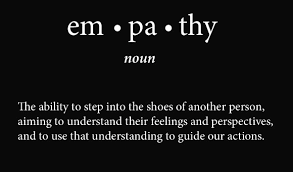
Empathy allows you to connect.  It makes you human.  Empathy allows you to feel, or perhaps more pointedly, allows you to understand how the someone else feels.  Having empathy is different from having sympathy.  Many people feel they are the same.  They’re not.  They’re wildly different.  Sympathy is about compassion, “feeling sorry for”, whereas empathy is being able to relate to another person.

Great sales leaders can relate, or empathize, with how challenging it is to find good prospects.  They can empathize with how exhausting making 100 dials a day can be.  If it were sympathy, I’d be saying “I’m sorry you have to make those 100 calls today…I sympathize for you.”  But that’s not the case.  The goal of a great sales leader is to have their team know, that they know, what it’s like to walk in their shoes.  The team wants to know the leader has “been there, done that.”  Great sales leaders are able to demonstrate empathy without effort because they can simply relate.  They’ve carried the bag, they’ve suffered the rejections, they’ve ended their day emotionally and physically exhausted without a sale in hand.  They’ve lived it.

Great leaders are not scared or intimidated to show empathy.  They don’t see it as a weakness to say “I went an entire week once not selling a thing”.  They’re not excusing low or poor performance by providing sympathy.  In fact, instead, what they are saying is I’ve had some moments like that myself and here’s how I pulled myself up and turned the corner.

We’re emotional beings.  Period.  We want to know we connect.  We’re pack animals.  Knowing we’re understood is critical.  Top performers, no matter what the profession, just want to be understood.  They don’t want sympathy and they don’t want anyone to “cut them slack”.  They want encouragement.  Not cheerleading.  There’s a difference.  Encouragement provides direction, a path.  Cheerleading provides nothing but a temporary high.

If you want to supercharge your leadership focus on developing your own personal level of empathy.  How do you relate to others?  What do you say to people who are struggling?  If you can improve your empathy skills you can improve your results, and the results of those around you.  Now you’ve created two wins.  Now you have momentum that will carry you and your team forward, and that’s what it’s all about.


5 Investments You Should Make in Yourself Today

books

Your mind and body are indeed your most valuable assets.  Most people would say their home.  And while on paper that may be true, without your mind and body nothing else matters.  Here are 5 investments you should make to strengthen both:

  1. Read – Your brain is the most important organ in your body, controlling all bodily functions including your muscles and other organs.  Reading, especially fiction, improves your brain connectivity and function according to a recent Emory University study.  In addition to the health contribution reading has on your brain, it also helps in developing your thinking skills, perspective, and decision making skills by filling your brain with more ideas and insights.
  2. Exercise – Study after study, year after year, we know that exercising each day produces huge benefits for the body, mind, and soul.  According to WebMD, the body’s release of endorphins caused by exercise increases self-esteem, reduces the perception of pain, and creates a positive feeling in your body. Knowing this, how could anyone argue against the value of exercise?  If you’re working out now, great job.  Continue.  If you’re not exercising now, start with just 30 minutes, 3 days a week.  A walk, a jog, push-ups, whatever you chose but start.
  3. Pay it Forward –  Time is your most scarce resource.  Some people horde it.  Others squander it.  I’d suggest you invest it in others.  I spend hours each week with people in my network.  I’ve helped countless friends and associates with resumes, interviewing tips, sales strategies, branding practices, and other areas where my expertise can add value to them.  I am most excited, most engaged, most rewarded when I know I’ve helped someone improve and develop themselves.  For me, paying it forward creates a feeling of pride, improves self-confidence and raises self-esteem.
  4. Clothing – Here’s a tricky one. Remember the saying, “dress for the job you want”?  Whether you like it or not we’re a society of first impressions.  That means that what you wear does matter.  You don’t need to break the bank for a good look.  Guys, you don’t need a dozen suits in your closet.  You can alter the look of one suit with ties.  One black, or blue suit, has endless possibilities by changing your tie.  Ladies, same thing for you with the exception of accessories.  Pins, necklaces, blouses can quickly change the look of a single suit.  If you’re working in a more casual environment dress “crisply”.  Pressed shirts, nice jeans or kakis, etc. Remember, work is still work, not a party, not a social gathering.
  5. Accessories – Everything from glasses, watches, briefcases, portfolios, pens, earrings, jewelry (not too much), pocket squares, cuff links, and shoes.  This is another area where investing in just one or two accessories can make a big difference.

Where Wisdom and Experience Intersect

wisdom

Great leaders possess many characteristics.  Courage, foresight, perspective, and vision are just a few thoughts that come to mind when thinking about leaders.  Leaders are not all-knowing, nor do they have to be right all the time.  In fact, knowing everything is impossible, and being right all of the time simply means you haven’t tested the boundaries.  Good leaders fail.  Great leaders fail often.

It’s been said that “wisdom is the result of experience, but experience is often the result of lack of wisdom.”  So where do the two intersect?  People ask you for advice because they admire your wisdom.  Job opportunities because of your wisdom.  Yet if it weren’t for all your failures you’d have nothing to offer, you would lack wisdom.  Great leaders possess this knowledge because they understand the importance of failure. They are able to see failures as deposits into their bank of wisdom, not withdrawals or setbacks.

Wisdom allows us to take chances.  It allows us to predict outcomes.  It enables us to maximize our chance for success but it does not guarantee our success.  Wisdom gives us the courage we need to attempt something that carries the risk of failure but doesn’t prevent us from trying.  Failure must be an option as we try new things and expand our horizons.  Wisdom helps us see that what we gain from these failures often times outweighs succeeding on the first try. 

So when confronted with a choice between a sure thing and one that presents potential failure, look first to your wisdom bank.  Do an honest assessment of what you will gain versus what’s at risk if you chose to take the chance.  Know that if you do take a chance and fail, you now have wisdom to share with others.  It is this wisdom that increases the value of your insight, perspective, and experience.   It is this wisdom that makes you unique.  This is the wisdom that enriches you personally, and the wisdom that develops you as a leader.

Are You Losing Sales? It’s Probably The Last 3 Feet.

table

Successful outcomes are the result of many different elements including preparation, practice, and skill.  With every action comes a reaction and the intensity of that reaction can be linked to the effectiveness of the originating action.  If you walk at a slow pace for exercise it will take longer to work up a sweat as opposed to a brisk walk or even a jog where you will sweat much quicker.  Action versus reaction.

How often have you left a sales call wondering where things went wrong?  You didn’t get the business.  The prospect seemed on board but decided to go in a different direction.  That reaction, whether we’d like to admit it or not is the direct result of an action we took at some point during the sales process.  In fact, the primary action that results in lost sales is communication.  Clarity of communication, followed by the ability to process that communication, is where many sales people fall flat.

In his book Exceptional Selling, Jeff Thull talks about “the last three feet” as being the distance that separates a prospect from a sales person sitting across a table from one another.   How often have you felt you’ve done everything right and in your final meeting – in that last three feet – with the prospect, you learn they decided against doing business with you?  It’s happened to us all at least once.  If you have been selling for years it’s most likely happened hundreds of times.  But why?

The main reason for this disconnect centers around a miss fire in communication.  You either said something to the prospect that turned them off, or you said the right thing that disqualified them as a prospect but you were too stubborn to see it.  We’ve all been taught to never walk away from a sales opportunity.  Further we  have been told for years that everyone is a prospect.  These ideas are just flat-out false.  Not everyone is a prospect and the quicker you find out who presents a real opportunity the better you’ll become at selling.  Remember your time, money, and energy are only of value to you so protect them.  The faster you can sort the real opportunities from the imaginary the better.

Watch for my next blog when I’ll present a sales strategy I have used with great success that eliminates the risk of the last three feet.


What It Means To Lean In

Trapeze

Life happens.  We have ups and downs, good times and bad, successes and failures.  It’s easy to be positive and happy when all’s going well but the reality is that nothing goes perfect forever.  Eventually even the best of us, the hardest working among us, and the most optimistic will be tested.  That’s life.  How we deal with those tests determine our success, state of mind, and fulfillment.  Notice I said fulfillment and not happiness.  Fulfillment in life comes from experiencing all life has to offer including the good and bad.  We learn and grow far more from our failures and the bad stuff than the good.  It’s during the times we are tested the hardest that our character comes to light and we grow as human beings. So how do you handle the bad times?  How do you deal with some of the tests life throws your way?  You lean in.

Years ago I was working through a rather difficult period in my career.  I was running Sales for a company that was in turnaround mode.  The company had experienced some success but was on the ropes with just about everything seeming to go wrong.  Sales and service were both failing and cash was tight.  Our employee morale was withering away to nothing.  With each stumble there were layoffs and cutbacks which led to a growing distrust across the employee population.  I had never seen anything like it before, and what had worked for me in the past wasn’t working now.  Frustration was running high and doubt was setting in.  That’s when I talked to Jeff.

I shared my thoughts and concerns with Jeff, a Board member and mentor.  I walked him through my plans, my thought process, and my confidence level relative to making the turnaround.  As a hugely successful entrepreneur, businessman, and corporate CEO, Jeff listened, sat back and said, “You’ve got all the right pieces. You’ve thought everything through.  Now you’ve got to lean in.”  This was the first time I had heard this phrase.  It certainly sounded good coming from Jeff but I needed to understand exactly what he meant by it, so I asked.

Leaning in, is about positive momentum.  If you’re on your heels self-doubt and second guessing quickly set in and you’ll surely fail.  You could have developed the best plans possible but failure will still visit you because you lacked conviction. Fear of failure causes us to lean back.  Failure makes us second guess ourselves and those around us.  It makes us focus on the wrong things.  When we lean back we’re looking for a way out, an excuse, someone to blame. We often get caught up in worrying about how others will perceive us should our plans not work out.  Fear that our personal reputation will be tarnished. And by leaning back we don’t fully commit.  We have one foot in and one out.  We’re the trapeze performer with a safety net under us.

In listening to me Jeff sensed I was leaning back.  He knew I had put a great deal of thought into the plan I developed.  He knew I identified the most probable risks and put plans in place to mitigate them.  But I was still leaning back.  He stressed the importance of leaning in.  He said, “Imagine you have no safety net under you.  What would you do?” And then he said the one thing that all great leaders don’t just say but demonstrate…he said, “Joe, I support everything you’re doing.”  Those words, backed-up by my faith and trust in him as a leader, gave me the added strength I needed to lean in.  To commit and not look back.

So when tough times arrive, or when everything seem to be going wrong, lean in.  Way in.  Imagine not having the safety net and that’s when you’ll realize that failure is not an option and you’ll make a bad situation into a good one. And most importantly find your “Jeff”.  A mentor is an absolute necessity to help you navigate the stormy waves of life.

10 Things a Leader is NOT

Badleader

Remember that bad boss you had a couple of years ago?  Every interaction caused stress, disappointment, and sometimes regret.  Here are some characteristics NOT found in great leaders.

  1. Selfish.  Great leaders make it all about their teams.  There’s no “I” in team and the leader knows that and embraces it.
  2. Mean-spirited.  Strong leaders lead with dignity.  They understand that even when corrective action is required every employee deserves to be treated with dignity.
  3. Know-it-all.  The best leaders are continuous learners.  They do not claim to have all the answers nor do they believe they themselves are the only ones capable of generating great ideas.
  4. Placating.  Successful leaders understand the need for honest and direct communication.  They do not shy away from conflict or pander in order to win popular opinion.
  5. Narcissistic. Effective leaders have an inner confidence that allows them to operate without ego.  Not so say they don’t have an ego but they are able to keep it in check.  They don’t have a need for others to know who they are, what they have, or how important they believe themselves to be.
  6. Micro-manager.  Accomplished leaders know that they must have the details but cannot micro manage.  They give trust to their teams and provide opportunities to people to take risks and practice their decision-making skills.
  7. Disingenuous.  Thoughtful leaders know the importance of service to others.  They have a strong moral compass knowing that others can see clearly who they are and likewise can feel their authenticity.
  8. Thankless.  Purpose-driven leaders understand the importance of gratitude.  Being gracious for a job well done separates a good leader from a bad leader.  There’s nothing wrong with expressing your gratitude or thanks to an employee who did a good job even though a good job is what’s expected.  It’s often the smallest acts of kindness that embolden a team to its leader.
  9. Ignorant.  Learning leaders recognize all things change including their products, their markets and their customers.  They can’t afford to be caught with the short end of the intellectual stick and are constantly working to educate themselves and their teams.
  10. Indecisive.  Enduring leaders know that making decisions are required for leadership longevity.  Those that shy away from making decisions, difficult or easy, don’t last long as leaders.  Indecisive leaders are some of the most difficult leaders to work for.

And one bonus characteristic that ALL leaders DO possess…ownership.  All great leaders embrace ownership.  Ownership of their teams, their decisions – good or bad – their plans, strategies, ideas, and opinions.  These great leaders never look to place blame, often times to a fault.  They are able to shoulder great weight and responsibilities with a sense of ease and grace.

Are you a good leader?

What it Means to be Authentic

Authentic

You’re nervous, scared.  You’re breathing is shallow and you’re beginning to sweat.  Your mind is racing but you can’t seem to find an answer to your problem that makes you feel good.  In fact all you see in front of you are choices that are not so good and plain bad.  You start weighing the outcomes of each choice in terms of personal perception.  How will I be viewed if I make this decision or that decision?  How popular or unpopular will I be for making such a decision?  Will my boss support me?  How about my wife/husband, my friends, my parents, my kids?  Your emotions reach a crescendo and you feel you’re about to collapse.  What now?

Try this interesting test.  It’s a simple and fast test that requires answering just one question no matter how difficult the decision is you are facing.  It can serve as your decision starter.

What would I do if I didn’t have to worry about any one persons reaction or perception of me based upon the decision I make?  Sure this sounds unfair but if you begin every decision thinking first about what others will think of you then you’re likely to arrive at the wrong place.  Like politicians that look at polls before deciding on their personal stance on an issue, people who worry more about what others think rather than doing the right thing will ultimately experience a short life cycle as a leader.

Authentic leaders don’t worry about what others think.  Not that they set out to offend, hurt, or alienate themselves from others but they instead focus on being true to themselves first.  After all, that’s what makes an authentic leader so appealing to follow.  You always know where they stand on an issue today and tomorrow.  They don’t waiver or pander.  They simply establish their position, communicate it effectively and stick to it.  If they do change their position it is backed up by facts and tangible learnings that justify their change.  Not at all based upon opinion polls, or pressure from stakeholders or markets.

They have a sense of intelligent fearlessness.  They are smart enough to understand where the pitfalls are but effective enough to lead through, around, or over them.  They are mindful of cause and effect and focus on communicating both the why and the implications of their decisions.  They are often times seen as bold, courageous, and confidence.  They use their intelligence to assess the situation and select the best approach.  Their intelligence coupled with their confidence in conviction allow them to lead others fearlessly toward the goal.  This does not mean carelessly.  The difference here is that an authentic leader through their personal intellect and confidence are able to make tough decisions without fear, while leaders whose only strength is to pander to public opinion live in constant fear of being judged.  As such the leader who lives in fear is always looking to make the decision that allows them to place or shift blame elsewhere.  To have cover when the sky begins to fall.  Authentic leaders understand the risks and have no problems being held accountable to their decisions.

Recently Kathleen Sebelius was replaced as the Secretary of Health and Human Services (HHS).  In the interviews that have followed since her removal from office she stated that they had got it (the website http://www.healthcare.gov) readiness wrong.  It should have never been promised to roll out in October 2013.  Yet video clip after clip shows Sebelius saying with conviction it will be ready.  It is ready.  It’s working.  It’s right.  So where was her authenticity as a leader?  Where was her courage?  Unfortunately like so many others in leadership positions she sacrificed her authenticity for popularity.  If only people would realize that popularity is fickle.  Eventually inauthentic decisions and the leaders who made them always show themselves but by that time both have been cast as failures.  If only we could stay true, stay firm, stay authentic from the start.

Taking The Lead Vs. Being a Leader

leader

I’ve built many sales and marketing teams over the years.  I’ve led many to success and some to failure.  Throughout my career I have learned a great deal about leadership and leading people to achieve a desired goal.  One of the important facts I’ve learned over the years is that there is a clear difference between taking the lead and being a leader.  Having a true understanding of this difference helps to effect the best possible outcomes.

The difference between taking the lead and being a leader is quite simple.  When you take the lead you exert control.  You see examples of people taking the lead everyday throughout the world.  Kids take the lead to be the captain of the kickball team at lunch.   Executives maneuver to take the top spot in a company that may be floundering.  Yet these examples and others like them do not demonstrate leadership.  They simply showcase situations that arise where there is a vacuum at the top and any opportunistic person has the chance to step in and take control.  But that’s not leading.

Taking the lead involves control.  It often times results in a new regime rising to the top that is less focused on the team and much more  focused on an individual or small group of individuals.  This is not to say that in times of need that someone with noble intentions can’t rise to the top and become a leader.  Those situations do happen but are less likely when there is a leadership vacuum at the top.

The most significant difference between taking the lead and being a leader boils down to one ability.  The ability to inspire.  Great leaders inspire.  They get people to dream big, to not accept the status quo, to challenge conventional thinking without fear of embarrassment or disappointment.   The best leaders inspire people to own their own destiny.  To not settle for mediocrity.  To live the change we want to become, as Gandhi said long ago.  Leaders who are able to inspire possess a quiet confidence.  A sense of conviction that is both strong but flexible.  Strong leaders are learners and adapters.  They are able to see things as they are while formulating a plan to shape the future they intend to create.  They are driven by the need to be of value, and of service, to others and they inspire the very best from each of us while doing so.

These highly favored leaders are those  individuals that we all like to follow, to watch, to cheer on.  These are the people who make us feel confident in the value of our personal contributions, and are able to rally a diverse group of folks to charge off in a common direction.  They inspire each of us to reach for, and obtain greatness.  They are the real leaders.

Critical Insight When Making Tough Decisions

decision

If you need to make a difficult decision make sure you understand your surroundings as much as you understand the facts and details of what it is you’re trying to decide upon.

I recently had lunch with a colleague to discuss some key decisions that I need to make in our business surrounding strategy.  I presented my facts, beliefs, and experience with great passion.  My plan was both logical and well thought through.  I knew however that some of my decisions, while believed by the team the correct ones to make, would create some discomfort.  Why?  Because while we can all understand logic, and positive correlations, we are after all human beings, and human beings dislike change no matter how sound, logical, positive, or necessary that change is.

My colleague, who has years of experience and incredible wisdom said to me, “be aware of the issues that are not part of the issues.”  This statement perplexed me.  I didn’t understand.  When I asked her to explain she provided this wonderful story that provided the clarity to what she was saying.

For years she had her hair cut by the same stylist.  Through life’s many trials and tribulations, ups and downs, good times and bad, this stylist cut her hair and listened to her stories.  As times changed she wanted a new hair style but the stylist was unable to provide the cut she wanted.  She knew she had to make a change but her feelings and emotions of abandoning this stylist were strong.  She is an intensely loyal person and the thought of ending this long-standing relationship was quite troubling.  Her head told her it was the right thing to do but her heart was most certainly conflicted.  So while the issue at hand was achieving a new hair style, the emotional issue tied to her sense of loyalty came to the forefront of her making the decision to go elsewhere…hence the issue (emotional), not part of the issue (new hair style).

Bottom line:  It’s critical to understand emotions when making a decision. Your emotions as well as those of the key stakeholders involved in that decision are paramount to effective decision-making.  Emotional history, sometimes referred to as baggage, can play a major role in decision-making.  Being aware of these issues, that are not part of the actual issue being decided upon, can help you frame your approach.  Your decision is your decision.  It’s the “how” (the approach) you present your decision that can often times become the difference between effective decision-making and holding the status-quo.


The Positive Power of Regret

Regret

We’ve all done it.  Looked back and said, “Gosh I wish I hadn’t done that.”  Decisions we made, things we did or didn’t do that led to an unfortunate, uncomfortable, or disappointing experience.  Many times our failures can be tracked back to a decision we made, failed to make, or even made too hastily.  Likewise, success can be viewed in the same way.  But if you stop to look at the critical moments of your life, or your crucible moments as they’re often called, you may find a new tool in your bag worth using.  Regret.

Oddly enough “woulda, coulda, shoulda” could play a key role in helping to improve your decision-making.  How so?

Let’s imagine I have an important decision to make.  Could be personal, could be professional, it really doesn’t matter which.  I start by looking at the information I have in hand.  What do I know, what don’t I know?  What feelings or emotions strike me as I think through the different paths I could take in making this decision?  Perhaps I take the step to do a typical Pros and Cons sheet.  I write down all the positive things that could happen if I make Decision “A” along with the negative.  I do the same for Decision “B”.  I tally up all the pros from each chart and the one with the most is typically the path I take.  These are all fairly standard techniques in decision-making.  Now let’s add Regret.

Imagine 6 months have passed and you’re not in the place you had hoped you’d be.  Something went wrong along the way and things just didn’t turn out as you expected.  You’re unhappy, miserable, and regretting things.  Now come back to the present and ask yourself, what would I have done different to change that regretful outcome?  Maybe 6 months from now that diet didn’t work and I actually gained weight.  I may have regretted not working out 6 days a week, or eating that bag of potato chips every night.  Six months from now I may have failed my Chemistry class.  I may have regretted not studying enough, or asking for extra help from my professor.  Or maybe 6 months from now I’ve missed my sales goal again.  I may regret not making those extra calls each day when I quit at 5 pm.  I might regret not going to a networking event because it dug into my personal time.

Regardless of whether you have a personal or professional regret, using the positive power of regret may just help you make a different decision in the present that results in a better outcome in the future.  Regret can be a powerful tool when combined with visualization.  Visualize yourself in that unhappy moment, the failure you may feel, the disappointment that weighs on you.  Now take those feelings and ask what would I have done differently?  Regret often times gives you a second chance if you embrace it properly.

As Henry David Thoreau said, “Make the most of your regrets; never smother your sorrow, but tend and cherish it till it comes to have a separate and integral interest. To regret deeply is to live afresh.”