Innovation Paralysis

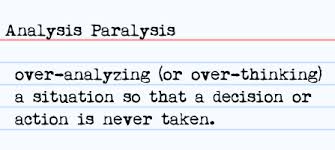
analysisparalysis


Many companies talk about innovation. Being innovative or even inventive can sound inspiring to prospective investors and employees. The promise of innovation can often attract new talent or keep impatient customers at bay. Hold tight, our new and improved version is on its way. We’re innovating as we speak.

The fact is the most companies aren’t innovative at all. Most are copycats. Copying another company’s idea is easier to do and carries less risk (assuming you’re not infringing on any copyright or patent laws). After all they’re the ones who have invested in true innovation.

For the most part, companies – even yours, may struggle with innovating. The biggest reasons for this struggle can be attributed to fear. Perceived fear is an emotion so powerful that it stops most of us in our tracks from taking action. It’s a mind game that creates countless scenarios that fill us with thoughts of failure and ridicule. We forget that most of the greatest inventions and innovations in history were the result of countless failures. Think of Ford, Edison, Jobs, and even JP Morgan. The fact is that failure fuels passion and passion produces results.

Strong leadership is required to lead an innovative company. If the CEO, owner, or leader lack the confidence required to discuss failures experienced by trying to innovate then a company simply won’t innovate. Unfortunately companies that take a follow-the-leader approach typically end up becoming irrelevant. The list is long and includes names like Kodak, Zenith, Pontiac, and Circuit City.

How do you know if your company is a company of innovation? Ask these questions?

1. Where are your growth ideas initiated in your company?
2. Was anyone ever fired for trying a new idea? Responsibly?
3. How often does denial come into your team meetings? The general belief is that alls well.
4. Are there regular meetings where idea generation is the only thing discussed?
5. Are off-the-wall, wild ideas solicited or is there more of a play-it-safe mentality that permeates your company?

These questions will provide insight into just how committed to innovation your company is.

Is a Leader a Solo Act?

alone

Yesterday the Wall Street Journal published an article on Bill McDermott, the CEO of SAP. The article profiled McDermott’s rise within SAP and the fact that this German company will now be at the hands of an American CEO for the first time in its history.

McDermott has placed his beliefs front and center, stating that SAP must move quickly and innovate. “There is no speed limit on innovation” McDermott told a crowd at a recent event. But herein lies a fundamental problem that challenges  the “believability” of that statement. Can innovation happen through the efforts of one person alone or does innovation require a team?

Today’s most admired companies are those that innovate. Companies like Amazon, Google, Apple, and ExxonMobil are all at the forefront of their respective industries due to constant innovation. Additionally, their ability to innovate is often credited to their employees and the teams they have assembled to drive some of the best innovations and inventions of our times. Yet McDermott seems to have chosen a “go it alone” strategy having terminated most of SAP’s previous leaders of innovation.

SAP’s advisory board seems to be in full support of Mr. McDermott and has done nothing less than support him in his me, myself, and I strategy. But will it work? Here are 3 areas where McDermott’s strategy may go awry:

1. Collaboration breeds innovation – even the late, great, Steve Jobs saw the benefits of team collaboration when launching the first iPod as referenced in the book Inside Steve’s Brain by Leander Kahney. Teams were assembled to take a raw idea and bring it to life. Contrary to popular belief, Apple’s success wasn’t Steve Jobs alone.
2. Checks and balance. Not having a #1 or #2 on your team can lead to beliefs of invincibility and disillusionment. Every leader needs a strong next-in-line. Believing that only you have all the answers or ideas is very risky. Beyond the benefit to the business, having the right #2 will stretch and challenge the leader to explore options he or she might have otherwise dismissed.
3. Competitive Intelligence. Much like the reasons for #2 above, it’s highly unlikely for one person to be “in-the-know” on all things at all times. I rely on my team as a unit to keep us all up to speed on current and trending market conditions. Having multiple inputs from different folks minimizes bias and assumptions.

So will SAP’s strategy work? Time will tell.

Where Chemistry and Leadership Intersect

Chemistry

Chemistry focuses on the relationship between atoms and other phenomenon. Cause and effect. How does an atom change when external factors are introduced. Had I only known then – 30 years ago when I took Chemistry in school – what I know today, I would have paid more attention.

Team building is all about chemistry. After all, the human body is made up of atoms and when two bodies are interacting it represents millions of atoms interacting with one another.  Interaction reactions are just as varied between atoms as they are humans.  Sometimes you just don’t know what will happen.

From our early childhood, to adult life, chemistry is at work in the choices we make and the outcomes they render. Remember those days on the school ground picking teams? Who did you pick, or at what point in the team-picking process were you picked? When you got your first management position how did you feel about your team? Were you able to make changes or new selections? If so, how did you go about doing that?  If not, how did you assimilate to your team?

I’d submit that chemistry is one of the single most important factors in establishing a successful team. The team’s ability to interact with one another given internal and external influences is a necessary requirement for a high performing teams. And like explosions that can occur when atoms are rammed together with great force, so too can human interaction experience similar explosions if not careful.

Here are 3 points to be aware of when navigating team chemistry:

  1. Have a clear vision.  Make sure that you’ve created the “destination postcard” for the team.  This represents where you are headed, why, how you’ll get there, and by when.
  2. Have clear rules of engagement.  Demanding honesty and input must be balanced with diplomacy and humility…even if it must be forced.  The team must understand what is expected, as well as, how they are expected to accomplish the “what”.
  3. Have clear values.  Stating your values and then demonstrating those values on a daily basis…walking the talk…is critical for your team to see.  You can’t state that you despise cussing and yet at every meeting use language to the contrary.  Your actions and values must be aligned at all times.

Be careful to not confuse good chemistry with the belief that you can only hire those that “think” like you.  That’s not the case.  Instead focus on attracting people to your team that “feel” as you do, hold similar values, work ethic, and attitudes.  Specific skills sets MUST be varied across a team but common values must be woven into the team’s fabric to succeed.  And that’s chemistry.


A Social Media Experience Gone Bad

disappointment

My job requires a great deal of domestic travel.  I’m typically on the road 75% of the time covering the entire country.  Living in Philadelphia there’s one airline that dominates this market.  I’ve traveled this airline since 1995 and have flown their top-tier status for years.  With more than a million miles under my belt I’d consider myself a pretty savvy traveler.  I’d also consider myself to be a loyal customer to any company that provides me with the right value equation – what I get for what I spend.  So what does all this have to do with social media?  Here’s the story.

Recently I was scheduled to fly out of Philly to Denver.  Shortly after midnight, the day of travel, I received an email alerting me that my flight had been canceled.  I called the airline and after I got the customer service agent out of bed he proceeded to tell me that the flight had been indeed been canceled but that he would help me out by getting me on the next available flight to Denver.  Imagine my surprise when he informed me that the next available flight was scheduled for the exact same time as the original departure.  Hmm.  In his ever groggy voice the representative informed me that he could not assign me a seat as this flight was “under airport control”.  Sounds reassuring.

Got to the airport only to be told that the only seat available on this new flight…which remember was scheduled for the exact same time as my original flight…was a center seat.  Needing to get to Denver I had no choice.  So, last row, center seat, sold out flight.  I proceeded to tweet this airways regarding my situation.  Moments later I received a response to my tweet that said “We’re sorry for the cancellation. Check in with a gate agent for a seat assignment.”  Wow, now that was helpful.  So I proceed to reply suggesting they offer me something as a consolation…a free drink, WiFi, something.  Response? “We’re unable to offer free WiFi or drinks we’re sorry for your disappointment.”

Needless to say this airways attempt at using social media to delight and wow a customer fell WAY short.  Their responses were cold, impersonal, and above all else…useless.

Fast forward a week later.  Same exact situation happens only this time in route to Dallas.  So I tweet again.  This time the response I receive is “We’re sorry we aren’t able to help you here however our agents are happy to assist.”  This airways just doesn’t get it.  What they’ve done is made a bad situation even worse.  No one has owned the problem, no one owned fixing it.  It’s an incredible game of shift the blame and move the shells around.  Simply awful.

So what could this airways have done differently to make this a better experience for the traveler using social media:

  1. Have a policy already in place that provides guidance to whoever is monitoring social channels as to what goodwill offers can be made to satisfy the customer
  2. Make the reply personal.  “I’m so sorry Mr. DeRosa.  That’s terrible.  Here’s what we can do to help…”
  3. Follow up.  Two weeks have now passed and I’ve heard nothing from anyone at airways.  They have my contact number, my frequent flier number, my home and cell phones, and nothing.  Clearly they believe they don’t need to be the Nordstrom’s of the skies.  In fact I’ve gotten better service at a Dollar Store than at airways.

So keep in mind that if your company is using social media to engage its customers it requires a true commitment.  It’s not something to dabble in.  Canned replies, form letters, and traditional customer communication does not work with social media.  Spend the time to understand this before getting involved.  If your company doesn’t have the time, resources, or patience to learn and understand social media then do all you can to ensure they never launch it lest it will lead to an airways like experience.

What It Means To Lean In

Trapeze

Life happens.  We have ups and downs, good times and bad, successes and failures.  It’s easy to be positive and happy when all’s going well but the reality is that nothing goes perfect forever.  Eventually even the best of us, the hardest working among us, and the most optimistic will be tested.  That’s life.  How we deal with those tests determine our success, state of mind, and fulfillment.  Notice I said fulfillment and not happiness.  Fulfillment in life comes from experiencing all life has to offer including the good and bad.  We learn and grow far more from our failures and the bad stuff than the good.  It’s during the times we are tested the hardest that our character comes to light and we grow as human beings. So how do you handle the bad times?  How do you deal with some of the tests life throws your way?  You lean in.

Years ago I was working through a rather difficult period in my career.  I was running Sales for a company that was in turnaround mode.  The company had experienced some success but was on the ropes with just about everything seeming to go wrong.  Sales and service were both failing and cash was tight.  Our employee morale was withering away to nothing.  With each stumble there were layoffs and cutbacks which led to a growing distrust across the employee population.  I had never seen anything like it before, and what had worked for me in the past wasn’t working now.  Frustration was running high and doubt was setting in.  That’s when I talked to Jeff.

I shared my thoughts and concerns with Jeff, a Board member and mentor.  I walked him through my plans, my thought process, and my confidence level relative to making the turnaround.  As a hugely successful entrepreneur, businessman, and corporate CEO, Jeff listened, sat back and said, “You’ve got all the right pieces. You’ve thought everything through.  Now you’ve got to lean in.”  This was the first time I had heard this phrase.  It certainly sounded good coming from Jeff but I needed to understand exactly what he meant by it, so I asked.

Leaning in, is about positive momentum.  If you’re on your heels self-doubt and second guessing quickly set in and you’ll surely fail.  You could have developed the best plans possible but failure will still visit you because you lacked conviction. Fear of failure causes us to lean back.  Failure makes us second guess ourselves and those around us.  It makes us focus on the wrong things.  When we lean back we’re looking for a way out, an excuse, someone to blame. We often get caught up in worrying about how others will perceive us should our plans not work out.  Fear that our personal reputation will be tarnished. And by leaning back we don’t fully commit.  We have one foot in and one out.  We’re the trapeze performer with a safety net under us.

In listening to me Jeff sensed I was leaning back.  He knew I had put a great deal of thought into the plan I developed.  He knew I identified the most probable risks and put plans in place to mitigate them.  But I was still leaning back.  He stressed the importance of leaning in.  He said, “Imagine you have no safety net under you.  What would you do?” And then he said the one thing that all great leaders don’t just say but demonstrate…he said, “Joe, I support everything you’re doing.”  Those words, backed-up by my faith and trust in him as a leader, gave me the added strength I needed to lean in.  To commit and not look back.

So when tough times arrive, or when everything seem to be going wrong, lean in.  Way in.  Imagine not having the safety net and that’s when you’ll realize that failure is not an option and you’ll make a bad situation into a good one. And most importantly find your “Jeff”.  A mentor is an absolute necessity to help you navigate the stormy waves of life.

10 Things a Leader is NOT

Badleader

Remember that bad boss you had a couple of years ago?  Every interaction caused stress, disappointment, and sometimes regret.  Here are some characteristics NOT found in great leaders.

  1. Selfish.  Great leaders make it all about their teams.  There’s no “I” in team and the leader knows that and embraces it.
  2. Mean-spirited.  Strong leaders lead with dignity.  They understand that even when corrective action is required every employee deserves to be treated with dignity.
  3. Know-it-all.  The best leaders are continuous learners.  They do not claim to have all the answers nor do they believe they themselves are the only ones capable of generating great ideas.
  4. Placating.  Successful leaders understand the need for honest and direct communication.  They do not shy away from conflict or pander in order to win popular opinion.
  5. Narcissistic. Effective leaders have an inner confidence that allows them to operate without ego.  Not so say they don’t have an ego but they are able to keep it in check.  They don’t have a need for others to know who they are, what they have, or how important they believe themselves to be.
  6. Micro-manager.  Accomplished leaders know that they must have the details but cannot micro manage.  They give trust to their teams and provide opportunities to people to take risks and practice their decision-making skills.
  7. Disingenuous.  Thoughtful leaders know the importance of service to others.  They have a strong moral compass knowing that others can see clearly who they are and likewise can feel their authenticity.
  8. Thankless.  Purpose-driven leaders understand the importance of gratitude.  Being gracious for a job well done separates a good leader from a bad leader.  There’s nothing wrong with expressing your gratitude or thanks to an employee who did a good job even though a good job is what’s expected.  It’s often the smallest acts of kindness that embolden a team to its leader.
  9. Ignorant.  Learning leaders recognize all things change including their products, their markets and their customers.  They can’t afford to be caught with the short end of the intellectual stick and are constantly working to educate themselves and their teams.
  10. Indecisive.  Enduring leaders know that making decisions are required for leadership longevity.  Those that shy away from making decisions, difficult or easy, don’t last long as leaders.  Indecisive leaders are some of the most difficult leaders to work for.

And one bonus characteristic that ALL leaders DO possess…ownership.  All great leaders embrace ownership.  Ownership of their teams, their decisions – good or bad – their plans, strategies, ideas, and opinions.  These great leaders never look to place blame, often times to a fault.  They are able to shoulder great weight and responsibilities with a sense of ease and grace.

Are you a good leader?

What it Means to be Authentic

Authentic

You’re nervous, scared.  You’re breathing is shallow and you’re beginning to sweat.  Your mind is racing but you can’t seem to find an answer to your problem that makes you feel good.  In fact all you see in front of you are choices that are not so good and plain bad.  You start weighing the outcomes of each choice in terms of personal perception.  How will I be viewed if I make this decision or that decision?  How popular or unpopular will I be for making such a decision?  Will my boss support me?  How about my wife/husband, my friends, my parents, my kids?  Your emotions reach a crescendo and you feel you’re about to collapse.  What now?

Try this interesting test.  It’s a simple and fast test that requires answering just one question no matter how difficult the decision is you are facing.  It can serve as your decision starter.

What would I do if I didn’t have to worry about any one persons reaction or perception of me based upon the decision I make?  Sure this sounds unfair but if you begin every decision thinking first about what others will think of you then you’re likely to arrive at the wrong place.  Like politicians that look at polls before deciding on their personal stance on an issue, people who worry more about what others think rather than doing the right thing will ultimately experience a short life cycle as a leader.

Authentic leaders don’t worry about what others think.  Not that they set out to offend, hurt, or alienate themselves from others but they instead focus on being true to themselves first.  After all, that’s what makes an authentic leader so appealing to follow.  You always know where they stand on an issue today and tomorrow.  They don’t waiver or pander.  They simply establish their position, communicate it effectively and stick to it.  If they do change their position it is backed up by facts and tangible learnings that justify their change.  Not at all based upon opinion polls, or pressure from stakeholders or markets.

They have a sense of intelligent fearlessness.  They are smart enough to understand where the pitfalls are but effective enough to lead through, around, or over them.  They are mindful of cause and effect and focus on communicating both the why and the implications of their decisions.  They are often times seen as bold, courageous, and confidence.  They use their intelligence to assess the situation and select the best approach.  Their intelligence coupled with their confidence in conviction allow them to lead others fearlessly toward the goal.  This does not mean carelessly.  The difference here is that an authentic leader through their personal intellect and confidence are able to make tough decisions without fear, while leaders whose only strength is to pander to public opinion live in constant fear of being judged.  As such the leader who lives in fear is always looking to make the decision that allows them to place or shift blame elsewhere.  To have cover when the sky begins to fall.  Authentic leaders understand the risks and have no problems being held accountable to their decisions.

Recently Kathleen Sebelius was replaced as the Secretary of Health and Human Services (HHS).  In the interviews that have followed since her removal from office she stated that they had got it (the website http://www.healthcare.gov) readiness wrong.  It should have never been promised to roll out in October 2013.  Yet video clip after clip shows Sebelius saying with conviction it will be ready.  It is ready.  It’s working.  It’s right.  So where was her authenticity as a leader?  Where was her courage?  Unfortunately like so many others in leadership positions she sacrificed her authenticity for popularity.  If only people would realize that popularity is fickle.  Eventually inauthentic decisions and the leaders who made them always show themselves but by that time both have been cast as failures.  If only we could stay true, stay firm, stay authentic from the start.

Taking The Lead Vs. Being a Leader

leader

I’ve built many sales and marketing teams over the years.  I’ve led many to success and some to failure.  Throughout my career I have learned a great deal about leadership and leading people to achieve a desired goal.  One of the important facts I’ve learned over the years is that there is a clear difference between taking the lead and being a leader.  Having a true understanding of this difference helps to effect the best possible outcomes.

The difference between taking the lead and being a leader is quite simple.  When you take the lead you exert control.  You see examples of people taking the lead everyday throughout the world.  Kids take the lead to be the captain of the kickball team at lunch.   Executives maneuver to take the top spot in a company that may be floundering.  Yet these examples and others like them do not demonstrate leadership.  They simply showcase situations that arise where there is a vacuum at the top and any opportunistic person has the chance to step in and take control.  But that’s not leading.

Taking the lead involves control.  It often times results in a new regime rising to the top that is less focused on the team and much more  focused on an individual or small group of individuals.  This is not to say that in times of need that someone with noble intentions can’t rise to the top and become a leader.  Those situations do happen but are less likely when there is a leadership vacuum at the top.

The most significant difference between taking the lead and being a leader boils down to one ability.  The ability to inspire.  Great leaders inspire.  They get people to dream big, to not accept the status quo, to challenge conventional thinking without fear of embarrassment or disappointment.   The best leaders inspire people to own their own destiny.  To not settle for mediocrity.  To live the change we want to become, as Gandhi said long ago.  Leaders who are able to inspire possess a quiet confidence.  A sense of conviction that is both strong but flexible.  Strong leaders are learners and adapters.  They are able to see things as they are while formulating a plan to shape the future they intend to create.  They are driven by the need to be of value, and of service, to others and they inspire the very best from each of us while doing so.

These highly favored leaders are those  individuals that we all like to follow, to watch, to cheer on.  These are the people who make us feel confident in the value of our personal contributions, and are able to rally a diverse group of folks to charge off in a common direction.  They inspire each of us to reach for, and obtain greatness.  They are the real leaders.

Why Failure is Your Friend

Failure

Years ago I read the book Failing Forward by John Maxwell and it had a profound impact on my life. I grew up in an ultra competitive home where me and my sisters were raised to believe that failure was not an option. As I entered the workforce and began my career I carried this belief with me only to learn, in short order, that failures can happen regardless of the actions taken.

From bad bosses (you know who you were), to poorly run companies (you know who you were as well) to jobs I simply didn’t like, failure began to approach my doorstep uninvited. I worked hard, pressed forward, acted with persistence and determination and still experienced my share of failures.  I’ve missed sales numbers, hired the wrong people, and had sales and marketing campaigns fall flat.  Yup, I’ve seen my share of failures.

Sometime after turning 40 I began to view things differently. For the first time I was able to look back at my failures not as failures but as critical learning events that took place at a moment in time. I’ve been battle tested, failed at times, yet have come out stronger each and every time.

We learn when we fail. In fact I’d argue the quality of education we get from failure is vastly better than the education we get from success. Success is simply the culmination of multiple failures. If at first you don’t succeed, try, try again. The greatest inventions ever were the result of countless failures. Many of the world’s most deadly diseases were cured only after countless failures while looking for a cure. Thomas Edison once said he it took more than 10,000 tries to invent the light bulb.  What if he gave up at 9,000?  I’d hate to think I’d be writing this in the dark.

The point is that we learn from our failures…if we allow ourselves to.  Here are 3 things that failure helps to improve:

  1. Decision making.  Making decisions is a tough business.  It requires speed, thoughtfulness, intuition, and experience.  Experience comes through both failure and success.  The more you have of both the better decisions you will make.
  2. Mental health.  The sooner you embrace failures as your friend and not your enemy the quicker you’ll be able to look at failure for what it is…a teacher.  You fall off your bike and you know it’s not the end of the world so you get back on.  You get laid off from a job and find another so now you know that losing a job isn’t a life sentence.
  3. Leadership.  Personally I want to work for someone who’s failed…at least a few times.  I’m much more willing to march into battle behind a battle-tested leader than someone who is entering their first rodeo.  Leaders who have lived the highs and lows are typically more stable offering a steady hand in times of stress as they’ve seen it before and know they can navigate through it.  While it may sound odd to say, failure is one of the biggest ingredients to building confidence.  The more you know you’re capable of handling the more confident you will be in yourself.

So rethink your opinion of failure.  It really is your friend if you let it be.

The Secret to Leading a National Sales Team to Success? Communication.

Win

Vince Lombardi said, “Coaches who can outline a play on a blackboard are a dime a dozen.  The ones who win get inside their player and motivate.”  This insight from Coach Lombardi speaks to the necessity for all leaders to understand their players and instill confidence while inspiring a desire for to achieve greatness.

Running a national sales organization is difficult. There are numerous challenges that come into play that every leader must deal with on a regular basis.  Cultural differences, time zones, and competition are just a few of the most pressing items that every sales leader encounters.

While there are many critical characteristics that make up a great national sales leader one stands above the rest…communication.  Communication is both art and science.  At its most effective level communication is a two-way street.  A give and take.  A back and forth.  It requires research, listening, understanding and patience.  Good communicators know what to say.  Great communicators know how to say it and when.  The right message delivered at the wrong time, in the wrong venue, or with the wrong tone can be just as disastrous as delivering the wrong message.  Great leaders know their people.  They understand what drives them.  What makes them tick.  Because of their deep insight into their people they are able to communicate at a higher level than those leaders who don’t take the time to get to know their people.

To be a great communicator you must do these 6 things:

  1. Educate yourself in your area of expertise.  It always amazes me how some folks believe that because they’ve been “in the business” for 10, 15, or 20 plus years they just know it all.  Their arrogance has misled them providing a false sense of security.
  2. Get to know your team.  Really get to know them.  Spend one-on-one time with them to understand who they are, what’s important to them, where they want to go, and when they’d like to get there.  Listen to them and be sure to focus all your attention on them.  We’ve all had those meetings where the person we’re talking to has “wandering eyes” and you just know they’re not hearing you.
  3. Practice.  Use a mirror.  Even after more than 25 years of building and leading large teams I still practice my message in front of a mirror.  Facial expressions are just as important as your message.  If the two appear disconnected your credibility goes out the window.
  4. Show empathy.  As the saying goes, “people don’t care how much you know until they know how much you care.” Empathy can only be developed when you take a genuine interest in helping others.
  5. Do it often.  The more you communicate with the right message the more transparent you become.  After all that’s what people want…transparency.  The ability to know what to expect without surprises is what builds credibility.
  6. Be clear.  Say what you mean.  Minimize the buzz words, big words, and impressive phrases.  No one cares how smart you sound.  They’re only interested in whether what you do can help them meet their needs.

Give it a shot and let me know how it works!