
A Remarkable Sales Lesson From Yankee Candle

Candle

Yesterday I went into Yankee Candle to purchase some of their awesome selling Balsam and Cedar scented candles.  I had a Buy Two, Get Two Free coupon.  My goal, as always when shopping, is to know exactly what I want, get in, get out, and get home!  I certainly hadn’t expected to get schooled in Sales while buying something as simple as a candle.  But I did.

Immediately upon walking in I was greeted by a very nice, “in-the-Christmas-spirit” sales associate.  She noticed I was a “man on a mission”, and asked what she could do to direct me to what I was looking for.  I told her I had a coupon for the buy 2, get 2 and I specifically wanted Balsam and Cedar candles.  She directed me to “get a basket” and then led me to the display where she then said “you want to buy the large candles with that coupon.”  I told her I was planning on getting the medium size jars.  What she said next hit me like a brick.  In all my sales career this was a first.  Her response was so quick, and so filled with conviction it just completely disarmed me.

She said, “Look…you went to college.  The large jar is $27.99 and the medium is $24.99 but the burn-time difference is 60 hours.  I know you can do the math.”  WOW!  This lady was spot on.  She used my own intelligence against me!  I did go to college and I could do the math.  With that I said yes, and out I walked with 3 Balsam and Cedar candles and a Mountain Lodge (my favorite) for a bit of variety.

On my drive home this experience got me thinking.  This lady’s style and level or persuasion rivaled any C-Suite sales executive I’ve ever dealt with and she was working for Yankee Candle!  While I might be wrong, I’m betting her sales skills were all her and not taught by Yankee.  If I’m incorrect I’d love to know more about their sales training program.

Yankee Candle Lady’s Sales Style:

  1. Smile.  The entire interaction she was smiling and genuinely cheerful.
  2. Recognize and acknowledge body language – “man on a mission”.
  3. Provide subtle direction – “get a basket”.  She’s in control.
  4. Respond accordingly – “follow me”, as she led me to the display.
  5. Know your product and your price points – “you want to buy the large”.
  6. Ready with quick reply to objection – “You went to college…you can do the math”.  Her response is disarming.  She’s challenging my intellect but subtly…and with a smile.
  7. Close the deal – she walks me up to the counter to be cashed out.
  8. Thanks me for coming in.  I wish her a Merry Christmas and she looks at me, still smiling and says “Merry Christmas to you too”.

What a truly unexpected and wonderful experience buying a candle!  Yankee, you’ve got yourself a Raving Fan! What do you think?

Why Empathy is Important for Sales Leaders

Empathy

Sales is tough.  Rewarding but tough.  Not every one is cut out for a career in Sales.  It’s the ultimate “what have you done for me lately” profession.  This year’s top performer is next year’s runner-up.  Being a salesperson requires high energy, discipline, tenacity and focus.  Great sales people possess the ability to visualize their success.  They can see themselves on the stage receiving The President’s Award, or cashing that big bonus check.  They’re high achievers, hard workers, and by and large, emotionally charged people.  Great sales leader have many similarities. But the really great leaders have more empathy than your average sales leaders.

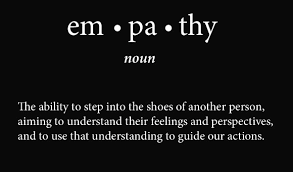
Empathy allows you to connect.  It makes you human.  Empathy allows you to feel, or perhaps more pointedly, allows you to understand how the someone else feels.  Having empathy is different from having sympathy.  Many people feel they are the same.  They’re not.  They’re wildly different.  Sympathy is about compassion, “feeling sorry for”, whereas empathy is being able to relate to another person.

Great sales leaders can relate, or empathize, with how challenging it is to find good prospects.  They can empathize with how exhausting making 100 dials a day can be.  If it were sympathy, I’d be saying “I’m sorry you have to make those 100 calls today…I sympathize for you.”  But that’s not the case.  The goal of a great sales leader is to have their team know, that they know, what it’s like to walk in their shoes.  The team wants to know the leader has “been there, done that.”  Great sales leaders are able to demonstrate empathy without effort because they can simply relate.  They’ve carried the bag, they’ve suffered the rejections, they’ve ended their day emotionally and physically exhausted without a sale in hand.  They’ve lived it.

Great leaders are not scared or intimidated to show empathy.  They don’t see it as a weakness to say “I went an entire week once not selling a thing”.  They’re not excusing low or poor performance by providing sympathy.  In fact, instead, what they are saying is I’ve had some moments like that myself and here’s how I pulled myself up and turned the corner.

We’re emotional beings.  Period.  We want to know we connect.  We’re pack animals.  Knowing we’re understood is critical.  Top performers, no matter what the profession, just want to be understood.  They don’t want sympathy and they don’t want anyone to “cut them slack”.  They want encouragement.  Not cheerleading.  There’s a difference.  Encouragement provides direction, a path.  Cheerleading provides nothing but a temporary high.

If you want to supercharge your leadership focus on developing your own personal level of empathy.  How do you relate to others?  What do you say to people who are struggling?  If you can improve your empathy skills you can improve your results, and the results of those around you.  Now you’ve created two wins.  Now you have momentum that will carry you and your team forward, and that’s what it’s all about.


Can You Tell If Your Culture Is Broken?

broken

Sales are down, customers are complaining and the board is losing patience.  You say you have a brand problem.  People aren’t aware enough, confident enough, or convicted enough to buy what you’re offering.  Why?

Is it because your marketing budget isn’t big enough?  Maybe you’re not running enough ads?  Or perhaps you haven’t paid enough attention to SEO and key words?  It could be some of these things, or maybe all of them.  I’d be willing to bet it might be something entirely different.  It might be your culture.

What you produce is a direct reflection of who you are, how you act, and what you value.  These are the things that make up a company’s culture.  They’re the sticky things, the messy things, the complicated things.  They are the ingredients that many executives (notice I didn’t say leaders), shy away from addressing.

I’ve read literally hundreds of company websites that proudly talk about their culture using words they refer to as their “values”.  They advertise these words like awards, placing them on a shelf like a trophy.  Inside the company however is a different realty.

Years ago I had a boss tell me, “if you have to put your values on a website they have no value”.  She further explained that “saying something is so, doesn’t make it so.”  I agree.  If, as an example, you list integrity as a value then what does it mean for the companies who don’t list integrity?  Does that mean they’re bad, or operate dishonestly?  Do you really need to say you value operating in a truthful manner?

I’ve seen countless companies where there is a disconnect between the stated values and the real culture.  The employees know it.  They see it.  They’re living it.  They’re wondering if anyone else notices the disconnect.  They become numb to the words because that’s all they are …just words.  Instead they watch actions.  They look for proof.  When they can’t find proof to validate the words the culture cracks.  It becomes fractured.  It fails to deliver a delightful experience to the customer because the delivery mechanism – the employees – is fractured.

Leaders hit this challenge head on.  Leaders are not afraid to tackle the hard stuff, the sensitive stuff, the messy stuff.  They stand in front of the company leaning forward, and take complete responsibility for the disconnect.  They own it.  They believe it’s their job to fix it, no one else’s.  They’re a leader.

The leader knows that fixing something, or improving it, begins with honestly.  They know that to make a positive impact they must be able to be honest with their team.  The team is too smart to misled.  They know the deal.  They’re listening for the truth, not fluff.  Only then will the team rally.  Only then will the team consider the remarkable.  Only then is the delivery of a delightful experience possible.  Until then…the broken culture is incapable of mending the brand. But the only way forward is for the leader to walk the talk.

The question is, do you have the courage to see things as they really are and deal with the messy part of business, or will you ignore it, explain it, and excuse it?  The choice is yours.  Be a leader.


5 Investments You Should Make in Yourself Today

books

Your mind and body are indeed your most valuable assets.  Most people would say their home.  And while on paper that may be true, without your mind and body nothing else matters.  Here are 5 investments you should make to strengthen both:

  1. Read – Your brain is the most important organ in your body, controlling all bodily functions including your muscles and other organs.  Reading, especially fiction, improves your brain connectivity and function according to a recent Emory University study.  In addition to the health contribution reading has on your brain, it also helps in developing your thinking skills, perspective, and decision making skills by filling your brain with more ideas and insights.
  2. Exercise – Study after study, year after year, we know that exercising each day produces huge benefits for the body, mind, and soul.  According to WebMD, the body’s release of endorphins caused by exercise increases self-esteem, reduces the perception of pain, and creates a positive feeling in your body. Knowing this, how could anyone argue against the value of exercise?  If you’re working out now, great job.  Continue.  If you’re not exercising now, start with just 30 minutes, 3 days a week.  A walk, a jog, push-ups, whatever you chose but start.
  3. Pay it Forward –  Time is your most scarce resource.  Some people horde it.  Others squander it.  I’d suggest you invest it in others.  I spend hours each week with people in my network.  I’ve helped countless friends and associates with resumes, interviewing tips, sales strategies, branding practices, and other areas where my expertise can add value to them.  I am most excited, most engaged, most rewarded when I know I’ve helped someone improve and develop themselves.  For me, paying it forward creates a feeling of pride, improves self-confidence and raises self-esteem.
  4. Clothing – Here’s a tricky one. Remember the saying, “dress for the job you want”?  Whether you like it or not we’re a society of first impressions.  That means that what you wear does matter.  You don’t need to break the bank for a good look.  Guys, you don’t need a dozen suits in your closet.  You can alter the look of one suit with ties.  One black, or blue suit, has endless possibilities by changing your tie.  Ladies, same thing for you with the exception of accessories.  Pins, necklaces, blouses can quickly change the look of a single suit.  If you’re working in a more casual environment dress “crisply”.  Pressed shirts, nice jeans or kakis, etc. Remember, work is still work, not a party, not a social gathering.
  5. Accessories – Everything from glasses, watches, briefcases, portfolios, pens, earrings, jewelry (not too much), pocket squares, cuff links, and shoes.  This is another area where investing in just one or two accessories can make a big difference.

Stop Hiding, It’s Time to be Remarkable.

dog

Long hair, short hair.  Clean shaven, beard.  New York accent, southern drawl.  Short, tall.  Heavy, slim.  Most people think of physical attributes when considering how remarkable they are.  Sure, David Beckham or Kate Beckinsale certainly turn heads but what truly makes you remarkable?  The answer?  It’s what you do and how you do it.

All of us have encountered remarkable people in our lives.  These are the people we remember.  The ones that made a difference.  They are the people that cared enough, shared enough, and gave enough to us that we walked away feeling beyond satisfied, feeling completely fulfilled.

The great author, Seth Godin, was one of the first to raise the concept of remarkable in his book Purple Cow.  Everyone can be remarkable. Few do, but all can. It’s a choice.  The fact is you’re already remarkable, you just need to show it.  We were all born with talent.  Your first job is to be self-aware enough to identify what your talent is and then live it.  Your second job is to understand your current circumstances and determine what actions you can take that will result in someone seeing you as remarkable.

Maybe you don’t want to be cold calling all day but that’s your current circumstance.  Your choice to gear up, toughen up and lighten up will come through your interactions as remarkable instead of choosing to be beaten up.  As inspirational writer John Maxwell says, “Your attitude determines your altitude.”  Not only is he right, but your attitude also determines just how remarkable you are, and can become.

Remarkability is not just about being different, or memorable.  If it were we’d have to include people like Hilter, Hussein, and Nero.  Being remembered is not being remarkable.  Being remarkable is having a positive impact in someones day, week, or life.  While others may define remarkable differently I would simply say that it’s about making others smile, happy, or feel fulfilled.  Perhaps that’s why nurses, pharmacists and fireman always top the list of most trusted professions, because in life’s most critical moments those are the remarkable ones we turn to.

Making the choice to be, act, and do remarkable things is all yours.  The world is waiting…needs you…to be just that – to be remarkable.


Confidence THEN Conviction

perception

Confidence is one of the most studied, sought after, and revered human traits. We all aspire to have confidence. The confidence to ask for a raise, or a date, or the confidence to ask for the business. Nearly everything we do in life requires confidence. But do you know what ingredient is needed to super-charge your confidence? It’s conviction.

 Years ago I found myself sitting in a meeting with the brilliant founder of Intuit, Scott Cook. In that meeting we were discussing why one of our product lines wasn’t acheiving the level of sales success we had anticipated. All of our research suggested it was due to a lack of brand awareness within that product category’s space.

At the end of our presentation Scott sat back and looked around the table. We were all quiet, anxiously awaiting his approval of the depth and quality of our work and findings. Instead he sat up, placed his arms on the table in a folded position and said, “I have a question. Raise your hand if you’ve ever heard of a Yugo.” We looked around the room at one another and quickly hands began to rise. Still looking around the room Scott then said, “Now keep your hand up if you’d buy a Yugo.” One by one hands came down and we now knew we were about to get schooled in the topic of brand awareness.

“Your problem is not with awareness. Your problem is that the market has no conviction in your product”. Scott effectively made the point that strong awareness without conviction equals failure. Our job was to instill conviction in the marketplace. Doing so required us to establish confidence first with our buyer. They needed to first “believe” we were capable of what we said we could do, and only THEN could they demonstrate their conviction to buy from us.

Establishing confidence begins with awareness, followed by increasing the buyers familiarity with your offering. Once familiar, the marketers job is to instill confidence. This can be done through a variety of ways including testimonials, surveys, samples, free trials, or a no-risk guarantee. Regardless of which method you use to instill this confidence it must be real before you can ask for the customers conviction to purchase.

To make this journey successfully you must be willing to truly hear what your customers are saying. You need to assess the marketplace. And perhaps most importantly you need to exude a personal conviction that by doing these things your business will grow with happy, delighted, and profitable customers.

4 Ways to Super-Charge Your Leadership

Headshot11.15.15


If you want to super-charge your leadership skills here are 4 things you should pay close attention to:

  1. Behaviors – What you do, when you do them, how you do them. Do your behaviors change depending on circumstances or do they serve as an unshakeable foundation even in times of crisis? Be cognizant that people are watching. Your colleagues, bosses, clients, partners, are all noticing your behaviors.
  2. Routine – In a recent Harvard Business Review, it was reported that great leaders have routines. They do things in certain ways, at certain times. They are disciplined and methodical in their actions. Leaders who are skilled at identifying their surroundings and circumstances are able to develop the routines that add the greatest value resulting in better results.
  3. Adaptability – Great leaders are capable of modifying their behaviors and their routines based on their circumstances. This requires the leader to be both a teacher and student all at the same time. Recognizing the need to adjust, and as importantly how to adjust, sets great leaders apart from those individuals who manage. Managers watch over a process. Leaders evaluate circumstances, determine a better way, garner resources, provide vision, and secure alignment. To do this, a great leader must be able to adapt.
  4. Seek feedback…genuinely and often – Interesting research from a number of trusted sources indicates that leaders who request regular feedback are more effective. Feedback improves your ability to empathize and connect with others. Unfortunately many people interpret a request for feedback as a weakness or perhaps insecurity. Leaders who ask from a number of sources – not just their boss – gain deeper insight into the organization, its issues, challenges, opportunities, and people. Having the ability to see into your circumstances is critical to your success. Don’t let others perceptions of feedback affect yours or worse prevent you from asking.

Great leaders learn, teach others, learn more, and repeat that process. Take these 4 elements and weave them into your daily leadership actions.


Where Wisdom and Experience Intersect

wisdom

Great leaders possess many characteristics.  Courage, foresight, perspective, and vision are just a few thoughts that come to mind when thinking about leaders.  Leaders are not all-knowing, nor do they have to be right all the time.  In fact, knowing everything is impossible, and being right all of the time simply means you haven’t tested the boundaries.  Good leaders fail.  Great leaders fail often.

It’s been said that “wisdom is the result of experience, but experience is often the result of lack of wisdom.”  So where do the two intersect?  People ask you for advice because they admire your wisdom.  Job opportunities because of your wisdom.  Yet if it weren’t for all your failures you’d have nothing to offer, you would lack wisdom.  Great leaders possess this knowledge because they understand the importance of failure. They are able to see failures as deposits into their bank of wisdom, not withdrawals or setbacks.

Wisdom allows us to take chances.  It allows us to predict outcomes.  It enables us to maximize our chance for success but it does not guarantee our success.  Wisdom gives us the courage we need to attempt something that carries the risk of failure but doesn’t prevent us from trying.  Failure must be an option as we try new things and expand our horizons.  Wisdom helps us see that what we gain from these failures often times outweighs succeeding on the first try. 

So when confronted with a choice between a sure thing and one that presents potential failure, look first to your wisdom bank.  Do an honest assessment of what you will gain versus what’s at risk if you chose to take the chance.  Know that if you do take a chance and fail, you now have wisdom to share with others.  It is this wisdom that increases the value of your insight, perspective, and experience.   It is this wisdom that makes you unique.  This is the wisdom that enriches you personally, and the wisdom that develops you as a leader.

4 Keys To a Better S.A.L.E.

Improve

No matter if you’re new to sales or a seasoned sales executive, brushing up on your selling skills is as important as changing the oil in your car regularly.  Leave the oil too long without changing it and your engine gunks up, gas mileage deteriorates, and in time your engine will fail.  Knowledge is to the sales person what oil is to an engine.  When you stop feeding your mind new knowledge your performance deteriorates and failure is around the corner.  But with so many things to think about, so many calls to make, numbers to hit, you don’t know what to focus on first.  So here’s a tip that will keep it simple…just remember SALE.

The “S” in Sale stands for structure.  Every sales person needs structure.  Some people are naturally disciplined and have strong internal structure while others require help to remain focused and disciplined.  Only you can be honest enough with yourself to know where you fall on the structure spectrum.  Structure includes when you make your calls, how your desk is set up, and whether your car is cleaned.  Structure speaks to your ability to organize.  Stronger organization equals higher efficiency which yields better results.

The “A” in Sale stands for attitude.  John Maxwell, the famous inspirational author, wrote “your attitude determines your altitude.”  Having a positive attitude is essential to success in life and critical to your success in Sales.  Have you ever met a sales person who seemed like they were on their last leg?  No more gas in their tank?  How did that make you feel?  Excited to buy?  Confident in purchasing their product…from them?  No.  No one wants to work with someone with a poor attitude.  No one buys from someone who lacks confidence in themselves, their product, or their company.  If you’re honest enough to recognize you have a confidence gap – read.  Thousands of books and books-on-tape are out their that can help.  Take action.  Don’t let another day go by with a bad attitude.

The “L” in Sale stands for learning.  If you’re not a continuous learning become one…and fast.  Albert Einstein said, “You have to learn the rules of the game.  And then you have to play better than everyone else.”  The rules of the game are always changing in Sales.  Your customer is evolving.  The internet and its ability to provide mountains of information will continue to change the game for years to come.  Better educated customers and prospects force a sales person to constantly up their game.  If you think the sales skills that won you awards 10 years ago, 5 years ago, or even last year will work in 2016 you’re wrong.  News flash!  If your buyer hasn’t already changed, they are in the process of changing.  Read.  As much as you can from as many sources as you can.  Commit to bringing one or two points from what you read that day into your sales conversations, then watch how your customer engagements change before your eyes.

The “E” in Sale stands for energy.  And lots of it.  Sales is physically and mentally demanding.  Some days are more draining that others.  Break up your day.  No matter how good you are you simply can’t sit and make 50 sales calls in a row without stopping.  While that may be physically possible, your energy levels will diminish and your customer will sense it.  Stay hydrated.  Drink 4 – 5 glasses of water throughout the day, or bottles if more convenient.  Stop for lunch.  If you don’t have the time for lunch keep an energy and protein bar handy.  You don’t want low energy levels to come across as poor attitude.  And make sure you get a work-out in daily.  Whether you start, or end, your day running, spinning, swimming or CrossFit, simply make sure to get some exercise in.  It will help keep your mind fresh, your energy up, and your endurance strong.

Happy Selling!