
3 Big Learnings from the Digital Growth Conference 2016

DigitalGrowthConference

This week I attended the Digital Growth Conference in San Francisco put on by SalesforLife.  It was a remarkable event packed with great content, inspiring and thought provoking speakers and some of the industries most respected thought leaders in the digital and social selling world. The attendees listened, asked questions, pondered, and talked with one another about how to effectively interact with today’s digital buyers, all while grappling with the ever-present challenge of how to transform our sales people into social sellers.

Here are my 3 Big Learnings from the conference:

  1. Today’s buyer is far more disruptive to the buying process than technology. Social selling evangelist Jill Rowley said during her keynote, “The buyer has changed more in the last 10 years than in the previous 100.” The disconnect between our buying habits and preferences as consumers, has not followed us into our businesses. Buyers are hyper-connected, plugged in, educated, informed, and knowledgeable. They are no longer waiting to be sold, but instead, they are controlling the sales conversation and process. This evolution begs a change to traditional sales processes. Your sales people today must be brand ambassadors both for your company’s brand, as well as, their own personal brand. Jill drove this point home by saying, “Your online digital footprint is how trust will be built before you meet your customer, your personal brand is so important.” The modern sales person sees this, embraces this, acts on it, and is constantly working to develop his or her personal brand. The question we should all be asking is, what about those sales reps who are not making the transformation to the modern sales representative? What to do?
  2. Since the buyer is now in control of the sales process, the job of the sales rep is no longer to sell, but to facilitate the buyers journey. Viewing a sale in this different light may be quite stirring…perhaps even provocative to many. However, the digital buyer is here.  There’s no going back. Sales people need to be socially engaged where the buyers are learning. It’s no longer enough to simply know where the buyer is.  The sales person now has to be interacting with that buyer before the sale in the places the buyer is learning and with those who are helping to educate and inform them. Tiffani Bova, Global Growth Strategist for Salesforce said, “How much of the journey they (the buyer) have gone through is irrelevant. It’s where they went in between that’s important.  Who are their advisors, where did they go to get info?”.  The sales rep is no longer leading with the sale, but leading the buyer to the sale. The question we should all be asking is what are we doing to aid in this transformation from a focus on the selling process to a deep understanding and alignment to the buyers journey?
  3. While the buyer has changed dramatically over the past 10 years, business has been much slower to change. Sure, it may feel to many that things at work are changing at light speed, but our sales process is still the same. Fill the pipeline, manage the pipeline, close the pipeline.  We may have changed the words we use, going from prospects, to pipeline, to funnel, but it’s still the same message, and same management. A true transformation to a buyers journey-centric focus requires great preparation, training, knowledge and assets that provide Sales with the tools they need to align with this “new buyer.” According to Sales Enablement guru Jim Ninivaggi, Chief Strategy Officer at Strategy to Revenue,” The #1 reason sales people fail to make a sale is due to their inability to effectively communicate the value proposition.” This reason, and its #1 ranking, hasn’t changed in 5 years. Why? The reason can be connected back to the disconnect between what we expect from our buying as a consumer, versus what we expect as a business person. This has to change.  To make this transformation we need to begin with hiring the right talent, providing that talent with the most effective on-boarding and training, and build a process that acknowledges the buyers journey by focusing on “education, solution, and selection.” It’s all about enabling your sales team to maximize all of their buyer interactions, because what got us here, won’t get us there. The question we should all be asking is what are we doing to better enable our sales teams?

As I reflected on my Conference take-aways on my flight from San Francisco to Philadelphia, I found myself thinking about the pace of change in our consumer lives and Moore’s Law – the speed of technology will double every two years. We all use technology to improve our lives, educate ourselves, inform one another, and buy things. The age of the customer has arrived.  They’re looking for an advisor. They want answers. And while today’s buyers conduct much of the buying process on their own, results of an Accenture survey presented at the Conference showed 65% of buyers still want a combination of digital and human interaction when buying.  This requires being there (where the buyers are), and being prepared (talent, training, knowledge, assets). Business needs to recognize and acknowledge these changes have happened.  We all need to begin to let our behaviors and expectations as consumers follow us into our jobs. Those willing, capable, and brave enough to make this transformation will be the companies that become the high-water-mark the rest will be chasing in the future.




An Execution Lesson for Business – Compliments of the Military

McChrystal

Planning is important. Training is important. People knowing what the goal is, and the actions necessary to attain the goal is critical.  But great planning and training is not enough to beat your competition.  Companies spend millions each year doing both. The infamous “strat plans”, and training sessions, and off-sites all take time and money. Yet the list of companies that actually execute on their plans and achieve their goals is a much shorter list than those that fail. So what’s the lesson that business can take from the military when it comes to successfully executing a strategy? The answer is organization.

A well-trained employee (solider) can not be effective operating in an unorganized environment.  A fairly trained employee operating in a highly organized environment can be very successful.

Current military leaders suggest that an enemy who is well-organized – regardless of training – is the enemy to be feared.  Likewise, companies with strong organizations, processes, infrastructure, and culture of execution, will take the talent they have and win nearly every time.  This understanding is summed up by the great management consultant Peter Drucker who said, “No institution can possibly survive if it needs geniuses or supermen to manage it.  It must be organized in such a way as to be able to get along under a leadership composed of average human beings.”

Are you organized?  Is your company?  Your department?  Do you have goals that are clear and understood by your entire team?  Have your “organized” your business around meeting those goals? Or have you simply created a new goal to execute within an existing organizational structure?

Goals change each year.  Sometimes more often depending on circumstances.  That’s the nature of business.  If all you do is change the goal without organizing you business around the specifics of that goal you’re bound to fail.  The old saying, “what got you here won’t get you there” will prove correct.  Take the time to test your goals against your current organization structure.  Chances are you’ll quickly identify gaps in your structure that may prevent or hinder the achievement of those goals.  Act quickly to identify them and address them.  Once you do…you’re on your way to successfully executing your plan.

Your Ability To Change Determines Success or Failure


hqdefault

Our ability to change determines our probability to succeed. Of course success has many definitions. Success may look like a college degree, a new car, losing weight, obtaining financial freedom, paying down debt, finding a new job, rescuing an animal, raising money for a nonprofit, starting a business, or growing a business.

No matter what you’re doing in life, your ability to manage change, embrace change, affect change, and ultimately lead change will determine the outcomes you produce. When people fail to change they don’t grow. They don’t expand their knowledge, or insights, or perspectives. They remain static within a dynamic world. When businesses fail to change the results can be stressful and sometimes catastrophic.  Downsizing, layoffs, reorganizations, increased leverage, bankruptcy, and in worst case scenarios complete shut downs happen due to a failure in the ability to change.

How can you prepare for change?

  • Read more, and if you’re not reading at all, get started. Create a mix of categories including business, leadership, inspiration, fiction, and history. There is so much to learn from others who have come before us, as those who are currently on their own journey.
  • Conduct a personal self-assessment. What are your strengths? Stop worrying about your weaknesses. Play to your strengths. In baseball, pitchers are known for having a perfect pitch. Could be their fastball, curve, slider, etc. Perfect your strengths so much so that your weaknesses are irrelevant.
  • Find a mentor. Someone who will be brutally honest with you about you. A great mentor will help you become more self-aware. They can identify blind spots. Blind spots may or may not be weaknesses. The key is to understand what they are, where they are, and when they show up. A blind spot may be how your temper flares when things don’t go your way. Once you’ve identified the blind spot you can work on techniques that can help change your behaviors.
  • Accept who you are. Sometimes the changes required to go from Point A to Point B do not align with your “who”. Don’t settle. When you attempt to do things that don’t align with who you are authentically, you will create stress in your life, and in the lives of others. Be happy with who you are. Don’t try to be someone you’re not. Once you’ve accepted who you are you can chose those situations or activities that excite you from a change perspective. If you love turnarounds but hate mature businesses, don’t force a change to work at a mature business. You love the excitement of turning something around. Chose to do that and whatever changes you’ll face in a turnaround situation you’ll embrace and thrive upon.
  • Reflection time. Build time into each day to reflect. Just 15 minutes each day will help you sort through what happened, how you acted, and the outcomes. More than likely you’ll arrive at the realization that a different action would have created a different reaction. It’s cause and effect. Take the time to think about your day, those you encountered, and what took place.
  • Ask for help. Change is tough. Even if you’re changing an area that excites you, inspires you, and motivates you, chances are it also scares you. Going through change alone is even scarier. Having a strong support network is critical. Family, friends, mentors, leaders and teammates can help you with change. I also personally believe that having a strong spiritual belief and faith provides a sense of calm during the storms of change.

Should You Clean House? The most difficult question you’ll face as a leader.

clean-house

Cleaning house is often times the first primary action a new leader takes upon his or her arrival; to fire or not to fire? If you’ve been recruited to fix, grow, turn around, or realign a team, there’s a strong chance you’ll be faced with this question shortly after you walk through the door.  It’s not an easy question to answer.  Turning over a team is physically and emotionally draining.  Yet, leaders are expected to make these difficult decisions in relatively short order.

The question of who, or whom, to let go requires a number of considerations.  Board expectations, executive management, the financial condition of the business, and company’s culture are all considerations when faced with this decision.  No matter what the circumstance, taking away an individual’s job is something that should never be taken lightly.  The reality is that many lay offs, reductions in force, or single terminations are decided upon from afar. But in cases where you are making these decisions locally you need to be prepared to act with confidence and compassion.

If you haven’t been specifically directed to change out a team, you’ll still need to evaluate your players to determine whether or not each individual will be able to make the transition.  You must recognize that the addition of you, the new leader, suggests changes have already been made, and more are likely expected.  Your personal style, philosophy, and work ethic are all new ingredients to this workplace recipe.  Will your team be able to transform?  Who will embrace the change and who will resist?  Remember all eyes are on you and your ability to lead change.  Resistors to the changes you plan to bring will become distractions, obstacles, and in the worst cases will strive for the workplace equivalent of a coup d’état. Your team’s alignment with your visions is critical. The sooner it happens, the greater the chance of you will succeed, and your company progresses.

A recent article in Fortune magazine, titled Should a New Leader Clean House?, author Geoff Colvin presents strong evidence that cleaning house produces better end results than those produced by leaders who attempt to work with the existing team.  The existing team is responsible for generating the existing results.  In many cases, a new leader is brought in to change those results, change trajectory, change outcomes.  Of course the focus is on the leaders ability to produce positive change.  The key is whether the probability of effecting positive change can happen with the existing team, or if the new leader needs to clean house first in order to start with their own team.

Noel Tichy, University of Michigan business professor, and former leader of General Electric’s Crotonville, NY training center, suggests “you need your own team.”  Your plans, ideas, and values will likely be realized by those excited to join the team versus those trying to hang on.  Reluctant followers ultimately become poison to the business killing results, morale, and the culture.

Finding the right path is up to you…the leader.  It’s not an easy decision, nor should it be.  You need to evaluate each member of your new team to determine their abilities and capabilities as they relate to embracing the transformation you’ve been hired to produce. Attitude is far more important at this stage that aptitude.  Perhaps the single most important piece to this puzzle is to ensure you have your boss’s support no matter what direction you make…keeping or cleaning.  Without his or her support your future starts out on shaky ground.  While this may be an uncomfortable discussion to have with your boss you need to have it…preferably during the interview stage, but if not then, immediately upon your arrival.  You’ll find alliances, allegiances, and “witness protection programs” in nearly every organization.  Knowing who they are, where they are, and the latitude you have to deal with them will determine your early and latter stage success.

Sales Enablement: A Sales Leaders Secret Weapon.

SalesEnablement

Every sales leader looks for an edge. They may have a dozen different levers they can pull in their attempt to improve results.  Some may provide a quick result, while others take time to build momentum.  The key is finding the right mix of short and long term actions that enable their team to sell more, in a shorter period of time. Introducing sales enablement can become the sales leaders secret weapon to achieve their goals today, tomorrow, and the next day.

The simple objective of sales enablement in any business is to maximize each interaction a sales person has with every prospect with the goal of winning the business. Said differently, it’s all about improving my team’s win ratios.  The major components of sales enablement include:

  1. Recruiting and On-Boarding
  2. Sales Training
  3. Team Development
  4. Conduit between Sales and Marketing

As a sales leader who has championed the introduction of sales enablement in a number of different companies I have experienced the following results:

  1. Improvements in selecting the right candidates – up to a 90% success rate in the first year.
  2. Significant decrease in ramp time – from 9 – 12 month ramp, down to 90 – 120 days fully producing sales representatives.
  3. More effective sales presentations leading to better outcomes – introducing sales training that focuses on providing a balance between knowledge and the application of that knowledge has created a 15 – 30% increase in close rates.
  4. A strong brand ambassador for the company – a better trained sales representative is more likely to project a sense of strength and confidence that likewise fosters confidence with the buyer.
  5. Great collaboration within the Sales team.  Sharing best practices that can be collected and put into a sales playbook creates energy, excitement, confidence and momentum for any sales team.
  6. Great collaboration between the Sales and Marketing teams. When Sales knows what Marketing is doing, and Marketing understands the outcomes of those efforts from a Sales viewpoint, alignment is created between the two.  Collaboration tears down walls and fosters a culture of learning, or testing.  When Marketing and Sales work together the business wins more than the revenue they created collectively.

I would love any stories you have on your sales enablement successes.  I’d also be interested to hear from the skeptics as well. There is a growing body of work on sales enablement that I’d be happy to share with those who are interested.

Are You a Helper, or a Server? An Important Question for Your Brand.


ChickfilA

Have you ever thought about what your company does?  I mean really does?  What is it you do? Why do you exist? What’s your purpose?  Are you a helper or a server?  Is there a difference?  Does it matter?  I’d suggest it does matter…greatly. Are you still wondering why the picture of the chicken sandwich?  Keep reading.

Pay attention the next time you’re in a buying situation.  You walk in a store, a restaurant, or car dealership, and in just about every possible example you’ll hear these four words – “can I help you?”  To help, as opposed to serving, boils down to a mindset.  We are taught as children to “help one another” in school, or to “help out” around the house.  As we get older the concept of helping others is seared into our brains as the right thing to do. Consequently in business, we bring those same thoughts with us, setting out to help someone or some business. But let me propose a different viewpoint; one that supports the benefits of serving others rather than helping.  An unexpected encounter at a quick-service restaurant brought this concept to my attention.

While on a recent road trip, my wife and I decided to stop for something quick to eat. We didn’t want to spend time in a full service restaurant.  We wanted something fast, and as close to healthy as possible given our travel schedule.  We pulled into a drive-thru and placed our order. From behind the audio box came a voice that was filled with energy (genuine) and asked, “How may I serve you today?”  What did she say? How could I be sitting in a drive-thru of a fast food restaurant and be this impressed?  This didn’t make sense.  We placed our order, pulled up to the window where we were greeted by a crisply dressed, smiling cashier who completed our transaction, and said, “thank you for your business and I look forward to serving you again.”  WOW!  That restaurant was Chick-fil-A. 

This experience got me thinking.  Who says “how may I serve you?”  Everyone says they want to help, but do they really?  “How may I help you” is regular, predictable, watered down. And how often have you heard those words knowing full well the person asking couldn’t care less about really helping you? But the question “how may I serve you?”, is a purple cow.  Something so simple, yet so remarkably different relative to today’s buying norms that you notice, and notice in a big way.

I wondered if this was a fluke or if there was something more to this one experience.  I conducted a bit of research and visited 3 other Chick-fil-As in different areas.  Shockingly, all provided the exact same experience as the first location. How can a company whose brand is represented by independent operators deliver such a consistent experience?  I just had to ask…

This remarkable service is the result of many things, but two things in particular: training and modeling.  Training content, material, philosophy, and methods are provided by corporate for consistency.  Modeling is provided by the independent operators.  The owners walk the same talk as all store employees.  One such owner that I had the privilege of meeting, walked around the store refilling customers drinks and asking if there was anything else she could do to serve the customers.  Remarkable.

When being served, you may feel special, perhaps honored.  When serving others you might feel fulfilled, satisfied, humbled.  As a result of this experience I have challenged myself and others in my network to give thought to shifting their paradigm from one of helping to one of serving.  I personally, have found this subtle shift in thinking to be empowering.  It fosters a bond between the one being served and the one doing the serving.  Try it and see what a positive change it can make to your customers’ experience.  Are you brave enough to serve or will you stay in your comfort zone and help?  You decide.


10 Phrases to Eliminate from Business Conversations

Slide1

As a curious, and active, participant and observer in business, I have developed a list of 10 phrases we should all strike from our business conversations. They add no value, and in many cases subtract from it.  While some of these may seem far fetched, I’d challenge you to zone into your conversations and listen for them.  They are in fact present in many business conversations each and every day.  Here they are, and what the person you’re talking to actually is hearing:

  1. Trust me – If I have to say these words, apparently I haven’t earned it.
  2. Believe me – Whatever I’ve told you must seem a bit far fetched so I’m left with this long shot request.
  3. To be honest – Up to this point I’ve been lying. But this next statement…is the complete and utter truth.
  4. I’ll tell you what – I’m annoyed with you.  You’re not trusting or believing me, so now I’ve just got to tell you how it is.
  5. Look – The ultimate smack-down.  Let me help translate this so a 5 year old can understand.
  6. It is what it is – I can’t tell if you believe me, or anything I’ve said.  I’m close to surrendering.
  7. Dude – I’m failing fast and scrambling to connect any way I can.  By the way, this is only used between guys…at least in my experience.
  8. I can’t say – Why not?  Well, this information is on a need to know basis and you don’t need to know…so I can’t say.
  9. We’ll figure it out – I’m not exactly sure what your concern is and why you’re worried about it.  I’m not about to try to understand it right now but “trust me” we’ll figure it out later.
  10. There’s no way – This one I find intellectually thought provoking as I have heard this used so many times in business. To be so “negatively definitive” about anything I find quite interesting. Imagine if any of the following people heard “there’s no way”…in fact you already know how they’d respond: Steve Jobs, Michael Jordan, Walt Disney, Jack Welch, John Chambers, Marc Benioff, Ronald Reagan, John Adams, George Washington,  JP Morgan, Thomas Edison…shall I keep going?  There’s always a way.  The question is NOT if there is a way, but instead, am I willing to do what’s necessary to find a way?

What are your favorites?  And what phrases get under your skin that I didn’t capture?  Looking forward to hearing!

Why Hiring Up Pays Off

SteveJobs

Building a high performing team is the #1 responsibility of all leaders.  It requires vision, skill, intuition, conviction and a clear understanding of the company’s objective and purpose.  It also requires courage.

Early in my career I received some hiring advice that was worth its weight in gold from my boss.  She said “hire people you wouldn’t mind working for in the future.” I have lived by this advice throughout my career and it has served me well.  Here are the two major take-aways from living this hiring philosophy:

  1. Your focus should be the candidates capacity, and desire, to learn new things and not based solely on what they know today.  To a large extent your focus should be on their attitude not their aptitude.  With the right abilities, the proper does of desire, and some passion, any one can accomplish anything.
  2. The circle of life is more than just a famous line from the movie Lion King.  Work in a management or leadership role long enough and you’ll experience people coming and going, and moving up and down.  I see it as a blessing that I have been able to provide leadership to many who have risen in the ranks, some even faster than I.  Being able to develop a new generation of leaders is something I’m most proud of.

By hiring up, you demonstrate confidence as a leader.  We’ve all seen leaders (I use this term loosely) who hire a warm body.  A robot.  Someone willing, and able, to take orders but not capable of having an individual point of view.  And then there are those leaders who everyone else wants to work for.  These are the people who hire up.  They look for those that are smarter than they are, have more ideas than they do, and who see the world through a different lense.

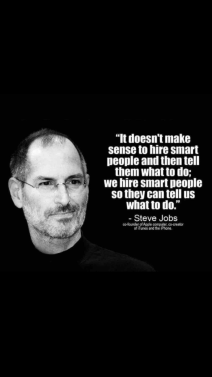
Assembling a team of talent that surpasses your own, demonstrates your leadership strength. I’d much prefer to be surrounded by people smarter than me than to be the only one with any answers.  There’s great truth to the saying, “if you’re the smartest person in the room, then you’re in the wrong room.” Build a team that can teach you as much as you teach them.  A team that can generate ideas faster than you can on your own.  A team that is willing to take on any issue, problem, or challenge because they know they have a better chance of winning by leveraging their collective brilliance versus trying to win with a single idea from just one person.  Hire really smart people and then get out of their way. I think Steve Jobs was onto something here.

Hire up.


Curiosity: The Key to Great Sales Talent


1b5805f16464a44669a42520558dc6ca

Is it really possible to hire great sales talent?  What makes one sales person succeed and another fail?  How does one sales person out-produce another, or an entire team?  Is there a secret trait, or characteristic, you should know about?  Average turnover in Sales ranges from 35 – 60% annually.  I’m aware of some companies where turnover is even higher, hovering in excess of 70%.  Imagine a sales force where 7 in 10 will be gone within the first 12 months.  Not a pretty picture.

If you’re building a sales team there are two traits that I have found to serve as a good barometer of future sales success; curiosity and the desire to learn.

Sales people must be curious. They should enjoy tinkering with things.  Changing things up.  Trying new things.  Asking tons of questions.  They should show a spark when presented with a problem, not shy away and become quiet.  Being curious allows a successful sales person to better understand their customers needs, the marketplace, trends, and possibilities.

The second trait that is a reliable predictor of sales success is the desire to learn.  Notice I didn’t say ability to learn.  We all have abilities…some natural, some taught.  However, what we really need is desire.  Desire speaks to what an individual will do regardless of what’s required.  If the desire is strong enough she will move mountains to accomplish what’s in her sites.

So how can you probe for curiosity and desire?  Here are some questions to ask during the interview process that will provide you insight on whether your candidate has these traits:

  1.  What would you do if you knew you wouldn’t fail at it?
  2. What was the last book you read? What did you learn?
  3. What LinkedIn groups do you belong to, and tell me about a discussion within that group that you found to be interesting and why?
  4. What types of books do you like to read and why?
  5. Who is your favorite author? Why?
  6. If you could start your own business what would it be and why?
  7. Who would you pick as your favorite leader and why?
  8. What is your preferred method of learning?
  9. What 3 adjectives would a client, or former colleague use to describe you?
  10. Tell me your 3 favorite questions to ask prospects
  11. What would you do if you won the lottery?

Selling requires strong critical thinking skills.  Critical thinking skills are developed  by expanding your insights and perspectives which happen primarily through learning.  The more curious someone is, the greater their propensity will be to be a continuous learner.

Let me know what you think.  Happy recruiting!

Preparing to Fail is the First Step to Winning

Failure

Some of the most important lessons we learn in life are from our failures.  They serve as proof that we are trying new things, pushing new boundaries, and welcoming the unknown.  John Maxwell, the famous inspirational author, says the quality that distinguishes someone successful from one who is unsuccessful is his “capacity to manage disappointment and loss.” He goes on to say that while we all want to succeed, we should instead train for losses.

From our earliest days as children we learn to accept failure.  We fall while trying to learn how to walk, or ride a bike.  We don’t make the team we try out for, or we do make the team but as second string.  We get accepted by 4 of the 5 colleges we apply to, but that one declination stings.  Failure is everywhere.

Imagine if the world’s greatest inventors refused to fail.  Everything from the light bulb, to air travel, from the television, to the computer would be at risk.  When Thomas Edison was asked about how many times he tried for the light bulb and failed he said, “I didn’t have 1,000 failures.  It simply took 1,000 steps to make the light bulb.” Talk about an optimists attitude.

Our challenge is to rid our mind of the negative stigma associated with failure.  Human beings by nature are curious creatures.  Asking “why” leads to testing new thoughts, ideas, ways of doing things.  In the absence of curiosity we would have never discovered new lands, new civilizations, new technologies, or new medicines to treat and cure disease.  So why is it that people run from failure?

I would submit that some people believe failure shows weakness.  If you knew…you wouldn’t have failed.  Talk about an absurd viewpoint.  The famous management expert, Peter Drucker, said, “I would never promote a person into a high-level job who was not making mistakes…Otherwise he is sure to be mediocre.” Many organizations reward status-quo.  Companies that find themselves on a winning streak become complacent.  Their leadership sits back to relax and enjoy victory.  The problem is, that while you’re sitting back complimenting yourself for being so brilliant, your competition is working feverishly to disrupt your success and pass you by.  It happens every day.

So shift your thinking from having to be an expert at everything to one of a beginner…a learner.  When you’re in a learning mode your mind is open to everything that’s possible.  When you’ve decided you are an expert your subconscious shuts down your critical thinking skills creating tunnel vision.  So open your eyes, let your mind wander, and begin to think of new ways to do things.  As John Maxwell said, “Mistakes are acceptable as long as the damage isn’t too great. It doesn’t matter how much milk you spill as long as you don’t lose your cow!”

Embrace your failures…with each one you’re learning, growing, and becoming better at whatever you’re doing.