Never Settle

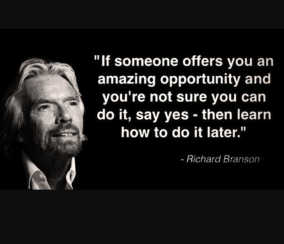
RichardBranson

Having a beginners attitude is a difference maker for great leaders.  They approach life with curiosity, questions, intrigue.  They believe anything is possible. They’re not afraid to try new things.  Their interest in learning and exploring is genuine, and it sends a strong signal to others who have a passion for innovation and invention, acting like a magnet.  These are the leaders that attract the best and brightest talent.

Real leaders are always preparing. They are in constant “getting ready” mode. They are always “on their way”, having not yet arrived, and as far as they’re concerned they never will.  In fact they believe if they finally do arrive it’s game over.  They never settle.  They never check the “all done” box. Real leaders are constantly looking for new challenges, new problems to solve, and new roles that push them out of their comfort zone – because that’s where the learning happens.

Nothing worth while in life happens without risk. No home run has ever been hit without taking a swing. The light bulb wouldn’t be here if Edison didn’t take a risk, both financially and scientifically.  Great leaders are comfortable with taking risk.  These risk-takers are not careless.  Far from it.  Rather they are prepared for it.  They believe in themselves, the skills they’ve developed, and their intuition.  They are comfortable with being uncomfortable.

So when someone offers you an opportunity do something different, think about it.  Push yourself to get comfortable outside of your comfort zone. Don’t shy away from a challenge.  It’s far more risky to remain static than it is to change. Don’t settle.  Be curious.

Stop Managing Change, Start Inspiring It

Leadership

Today’s leaders believe they must be skilled at driving change, leading change, and managing change.  It’s their job.  It’s what they are supposed to do.  But is it?

Many leaders wear their “change” credentials like a badge of honor.  They know how to drive change. What they might be saying is that they know how to force change.  Driving, or forcing change may in fact work initially, but if your “followers” aren’t aligned, in sync, or haven’t embraced the change because they can’t quite see or understand it, the change itself won’t last.  When you hear leaders describe their company as “always changing”, beware.  If something has to constantly change it may just mean that it hasn’t yet found its calling – it’s grasping at straws.

Also think about what image “driving” evokes. If you’re driving something that means you’re behind it.  You’re in the back pushing. How can you lead from behind?  Leaders should always be in front. Being in front may be symbolic, it may be ceremonial, but no matter it’s leadership.

If I force a change to take place, it’s likely that I’ll have to force another change shortly.  However, if I inspire change, if I rally those around me, if I can paint a clear picture on what that change will produce or deliver, then I have a much better chance of getting folks to rally not just around me, or the change, but around both.

If you’re a leader in any size organization consider this…

People don’t want to be led. Human beings simply don’t like being told what to do.  No.  Going back to the beginning of time our ancestors learned the importance of working together toward a common goal.  Whether that goal was to produce fire, transportation, or medicine, people need to understand the goal first, and believe that if they achieve that goal they will benefit and prosper.  Imagine if fire produced no heat, and no light.  What would the benefit have been to “invent” fire making?  There has to be a clear goal with benefits, to serve as the first ingredient to an effective change recipe.

It’s your job as the leader to provide this vision.  If you can inspire those around you to see the value in the change you’re suggesting you’re well on your way to building an effective, sustainable, and adaptable workplace.  Your team will trust you when they know why you’re asking them to do certain things and to make certain changes.  This does not mean you need everyone to vote in your favor.  No.  This is not about singing Kumbaya and holding hands.  Inspiring change is about leadership.  It’s about having the courage and conviction in the value of the change you’re asking to be made and those you’re asking to make it with you.


Caution! Employee Morale Not As Good As You Think.

employees.JPG

Employee morale seems to be quite high.  Management teams everywhere breath a sigh of relief after seeing their satisfaction surveys results.  They’ve got it under control.  People are happy and satisfied.  Executives look at this data and believe all’s well.  But it’s not.  Not really.

Many employee satisfaction surveys test for how happy, or satisfied, the employee is with the work they do each day.  But this measure can be misleading.  While I may love building spreadsheets, I might not like the environment in which I have to perform this work.  I may really enjoy creative writing, but don’t like the team I’m on, or the boss I work for.  Measuring how happy an employee is with the work they do, just might provide a false positive reading on satisfaction.

In a recent SHRM study, they surveyed 600 employees on 43 different criteria related to job satisfaction.  The overall employee satisfaction score came in at 86%.  However, in diving deeper into the analysis there is cause for concern.

The survey found the most important criteria to employees is being treated with respect.  Across all 43 criteria, 74% of employees rated this category as #1 in determining their satisfaction.  However, only 33% of employees gave this criteria a satisfactory rating.  The second most important category at 64% was trust between employees and management. Yet again there was another major disconnect with only 24% of employees scoring this criteria as satisfactory.

The lesson here is simple.  Reading the cumulative satisfaction score is comparable to evaluating someone’s health based entirely upon their ability to read an eye chart.  What about blood pressure?  Or cholesterol levels?  Or their weight?  I could have 20/20 vision, but be 100 pounds overweight with high cholesterol…am I really healthy.  There is so much involved in truly understanding employee morale and obtaining a true measure of their satisfaction.

In 20 years of building teams, managing teams, and leading them, I have found the only true measure of employee satisfaction is by having a genuine connection to your team.  Sending out a survey to trumpet a score, or a title on the greatest places to work list, can be quite dangerous if you place 100% confidence on just the score.  Dig deeper. Ask the tough questions. Be courageous. Be brave.  And most of all be willing to recognize that no company is perfect.  Think about that for a minute.  If there was a perfect company that would mean they have perfect employees.  If they had perfect employees that would mean you’d have no need for a performance review system as all of your employees would be exceeding (perfect) your expectations.  No.  Companies can only be as perfect as the people whom they employ.  So be ready to confront reality.  Be ready to take action to address all employment related criteria and not just those that are convenient.

Is it time to change?

The-Rol-of-Good-Communication-Skills-While-Introducing-Change

With nearly 200,000 books on “change” for sale at Amazon.com you can bet people are trying to understand change in their lives.  Whether it’s a new job, new boss, your first child, a different diet or a ruptured disc, chances are someone somewhere is trying to understand how it will affect their life.

Some companies spend years and countless resources to avoid change.  They operate under the “if it’s not broke, don’t fix it” model.  This mindset stifles innovation and simultaneously sends a message to employees to not try new things.  Sure we can all agree that New Coke’s introduction in 1985 was a miss.  It resulted in a drop in market share and ultimately ended in 2002 as Coke brought back the “classic”.  New Coke however represented a change.  It represented innovation regardless of the outcome.  Think about it.  Steve Jobs introduced the first PDA, Newton, in 1993 and just 5 short years later it was discontinued.

So when should you change?  Is change mandated by a timeframe?  Does your competition drive when you change?  Does your boss require you to change, or a merger that results in a new management teams arrival force a change?  Is it a measure of market share?

There’s no one way to advise someone, or a company, when the right time is to change.  My belief is that it’s better to change before change is forced upon you.  However, if you have a change mindset chances are you view change as a learning experience.  A way to grow.  A chance to expand your horizons.

In the movie, The 100 Foot Journey, Helen Mirren’s character, the owner of a one-star French restaurant who is in relentless pursuit of her second star, asks Manish Dayal’s character, a chef, why he changed a 200 year old recipe.  His response? “Maybe 200 years was long enough.”

Don’t change for the sake of change.  That’s silly.  Change because the thing you are altering, modifying, or adjusting will become better as a result of the change.  Perhaps the true result indicates the change wasn’t worth it.  I’d suggest to reevaluate a few weeks, months, or even years later.  When Steve Jobs was asked why Newton flopped yet the iPod took off, Jobs said the world simply wasn’t ready for Newton.  The infrastructure, specifically referring to the iTunes store, wasn’t ready.  Sometimes a change made today doesn’t make sense today, tomorrow, or next month.  But with time, an open mind, and a beginners attitude we can learn from all of our changes.  They instruct us, inspire us, and lead us to better outcomes.  Without change we become stagnant, static, irrelevant.  And who wants that?

How Pressure Affects Performance

Pressure

I work better under pressure.  Courage is grace under pressure.  When you work under pressure you trade perfection.  Pressure is something you feel when you don’t know what the hell you’re doing.

Perhaps somewhere along the way you’ve heard someone say one of these things, or maybe you’ve been the one saying it.  Regardless, pressure takes many forms, and delivers an equally different number of outcomes.  But harnessed properly, pressure can create a winning edge in business.  I had a former boss that said, “it’s my job to back the bus up as close to the edge of the cliff as possible without going over”.  That’s pressure.

Pressure develops our ability to adapt.  Under pressure we may be tempted to look for the path of least resistance yet it’s most likely that the situation created by this pressure has already eliminated all the paths without resistance.  All that’s left are the paths that present resistance ,including conflict, confusion, and discomfort.  The better equipped we are to effectively deal with the confluence of these challenges the better we are able to succeed.

While human nature leads us to avoid pressure I would submit that seeking pressure improves performance.  Diamonds are made under enormous pressure; without it they are just rocks; carbon deposits.  But with pressure they turn into beautiful gems of great, and often times, enormous value.  Top performing athletes are molded under pressure moments.  Peyton Manning holds the record for the most 4th quarter comeback wins with 44.  By definition, comeback, means pressure.  You’re behind.  You’re losing.  That’s pressure!

Look for opportunities to experience pressure.  Volunteer for a project at work.  Offer to bat clean-up on your baseball team.  Commit to losing a certain amount of weight in a specific period of time.  Tell others that you plan to get a certification or license of some sort by the end of the year.  All of these create moments of pressure. Only in times of pressure will you be able to see what you’re truly made of.  Remember how diamonds are made, and even further how that process creates the hardest, natural-made material known to man.

Consistency: The not-so-secret ingredient to building a strong brand

consistency-is-key

If I were to ask you to name your favorite brand what would you say?  What metric or definitions would you use to acknowledge those companies whose brands rise to the top?

Brand building is big work.  Heavy work.  Time consuming work.  It takes patience, curiosity, interest, a willingness to listen, a willingness to act, a conscious effort to deliver what you promise day in and day out.  Yes, a brand is simply that…a promise.

Chances are your favorite brands may do many things well, but there’s one thing I bet they do better than all the others.  I’ll bet your favorite brands deliver what they promise consistently.  Not 70% of the time, or 80% of the time, but 10 out of 10 times you get exactly the experience you’ve come to expect.  It’s exactly the reason you keep going back.  It’s THE reason it’s your favorite brand .

Consistency is the little, but not so secret, ingredient of successful brandsDunkin Donuts, Starbucks, and Wawa deliver great coffee all the time.  Apple delivers quality products for home, work, or on the go, that are easy to use and deliver what’s promised.  The gym I go to is always so clean you could eat off the floors which says a lot for a gym!  I drive 23 miles to take my car to a Cadillac dealership when there is a Caddy dealer 4 miles from my home.  Why?  They always recognize me by name, their waiting area is ultra-comfortable with TV, work stations and high-speed internet, not to mention their  “Nordstrom-like” restrooms.  Speaking of Nordstrom, their service is remarkable each and every time.  Whether you’re buying a brand name shirt, or one that carries John Nordstrom’s name, you can rest assured you’ve purchased something of quality.

We all have examples of our favorite brands.  What’s funny is how many companies I’ve experienced where paying attention to those little things is viewed as more of a luxury than a requirement.  Dunkin didn’t get the reputation for great coffee by accident.  They didn’t say “it doesn’t matter where we get our beans from or what type of equipment we use to brew it”.  They are all about those coffee details.  Nordstrom’s didn’t develop its reputation as service workhorse by giving customers a hard time when an item didn’t fit, work, or hold up as expected.  And for those of you privileged enough to live in a city where Wegmans operates you know how consistent their delivery of remarkable service is.  Wegmans has been known to take back, refund, and provide other goodwill gestures for food purchased that the customer didn’t like.  Consistently consistent.

If you’re selling fast and easy, it better be fast and easy all the time.  Not just most of the time. If you’re selling fresh, it needs to be fresh at 6 am or 6 pm.  If you’re selling durable, it better last under the harshest uses or conditions.

Regardless of what you sell, think about how consistent your brand delivers on its promise.  If it’s anything shy of 100%, or Six Sigma, I suggest you reevaluate and understand not just why, but what you’ll do to correct it.  Nobody wants to buy “sometimes”.  In fact most people buy with their emotions, and as human beings our emotions are wired for a “forever” experience.  People don’t like change and if your brand is inconsistent you’re indirectly creating a situation that will bring a change to your customer.  Not a good thing.  Consistently consistent.  That’s the key.


3 Hints to Help You Hit Your Goals in 2016: Hint #1 – Visualization

Goals

We all know goals are an important part of success.  Whether our objective is personal or professional, having a goal provides us with a “thing” to focus on to achieve that objective.

Over the years I have found 3 actions that have improved my ability to reach my goals.  I’ll share my hints this week.  Today, my first hint is visualization.

Visualization is a powerful way to gain clarity of your goal.  What is it you really want?  Can you see it?  What does it look like?

When I was younger I had a poster in my room with a picture of a mountain range in Arizona.  I was mesmerized by that picture and promised myself that one day I would live near the mountains.  And while I never got to Arizona I did move, and live in Reno, Nevada for two years at the base of the Sierra Nevada’s.  A goal achieved.

So what goal are you striving for in 2016? Is it a new house?  A new car?  A specific weight you’re trying to reach?  A book you’re trying to write?  A new job? A vacation? Bungee jumping?  Taking up a new sport or activity?

Find a quiet place to think.  Close your eyes and visualize exactly what the goal is you’re going after.  What does it look like?  Be as specific as possible.  Where is it?  What color is it?  How does it look?  What will you be feeling when you reach the goal; your emotions? When will you reach it? What’s the timeframe?

The more detail you can place around your goal through visualization the more likely you’ll be able to achieve it.  In his book The Success Principles, author Jack Canfield talks about how visualization activates the subconscious mind.  The more you visualize your goal the more your subconscious mind works to bridge the gap between your current reality and the goal you’re focused on.  He goes on to say, “Your creative subconscious can only think in pictures, not words.”  Having a clear picture, a visual, of the goal you’re trying to achieve is the first step to successfully achieving that goal.

Stay tuned for Wednesday’s second hint on improving your success in reaching your goals.


Leadership Is About Acting Now


Don’t put off until tomorrow what you could do today.  In Seth Godin’s book Linchpin, he says, “late is the first step to not finishing.” Many suffer from analysis paralysis.  Trying hard to solve for perfection.  Trying hard to not make a mistake.  Leaders however think about decision making differently.  They have the  courage to act and the confidence to own their decision no matter the outcome.

I might, turns into I can.  Leaders say I will, instead of I could.  I may, becomes I must.  I should, changes to I am.  Leaders think in the here and now.  They understand the importance of being decisive and accountable.  They look to the future with a clear understanding of their current circumstances.  Leaders are well-rounded.  They are continuous learners, who through learning, are constantly challenging their own perspectives, ideas and opinions.  Leaders are not afraid to change tact given new information.  They are more concerned about getting it right than being right.

In his book Who Says Elephants Can’t Dance, Lou Gerstner conveys a philosophy of “sooner is better than perfect.”  Doing things sooner often times requires getting comfortable with uncertainty.  The point being, once you have taken action you can always do a course correction.  Leaders are constantly acting.  They are in perpetual motion.  They’re never sedentary or static.  They’re fluid, dynamic, evolving.  

Leaders know that every journey begins with the first step.  Sometimes the step is in the wrong direction.  That’s okay.  They’re comfortable with change.  They’re confident in the midst of ambiguity.  They thrive on the thrill of what they can learn.  They’re curious.  They’re bold.

Be curious.  If being curious is too bold of a starting point then be cautiously curious.  Strive to become comfortable with being uncomfortable.  But act.  Taking action provides  the leader with learnings.  Those learnings add to the leaders inventory of skills, experience and perspectives.  With those ingredients the leader is able to garner the followers they need to successfully execute on their vision.

Keep moving.  Keep making things happen.

How Happy Are Your Employees?  Find Out in 3 Easy Steps.


Turnover. Theft. Sick time.  These are just a few ways poor morale manifests itself in the workplace.  Data shows that most employees leave a boss not a job.  Data also shows that stealing office supplies is actually less costly to the company that stolen time. Water cooler talk, extra long lunches, and lengthy hallway conversations are examples of stolen company time.  There’s a difference between hallway conversations that foster collaboration versus those that fuel the rumor mill.  But how do you, or can you – the boss – tell the difference?

Some companies spend thousands of dollars to survey and test for employee morale.  From an informal Survey Monkey to much more formal nationally recognized surveys, companies try to measure the engagement level of their employees on an ongoing basis.  What’s important to note is that these are only tools.  Best case they are a snapshot in time.  Worst case they are the result of highly skeptical employees providing the responses they think “big brother” is expecting.  Truth be told – and a truth many companies don’t want to acknowledge – is that most employees are highly suspicious of these “confidential surveys”.  I’ve worked in more than half a dozen firms where these survey’s were used and employee sentiment is generally the same everywhere.  This means that the results produced by these surveys are potentially flawed.  It also suggests to employees that it’s easier for management to send a survey rather than engaging them directly.  

If you really want to know what’s happening in your business be courageous and try doing these 3 things:

  1. Skip Level Meetings.  These are meetings where the boss meets with employees one ot two levels down in the reporting structure.  These meetings are meant to be informal.  The goal is to establish trust and to work to let the employee know how much the leader cares about them and their team’s morale.  
  2. Town Hall Lunch & Learns.  Keep groups small, no larger than 20 employees.  The speaking executive or manager should present a short “State of the Union.”  At the end of the presentation turn it over to the employees for questions.  If there are no questions the executive should work to engage the audience by asking for their opinions and why they feel the way they do.
  3. Management by Walking Around.  Abraham Lincoln was perhaps the first leader to practice this tactic.  It provides the leader with direct insight into the day-to-day workings of a business.  It also allows the leader to be seen as engaged and “in the fight” alongside their employees.

Whether you decide to try one, or all three, the key is to be authentic.  Employees know when you’re running through the motions.  They can spot inauthentic leaders a mile a way.  If you really don’t care, nor are willing to take action to address concerns you may hear, you’re better off not doing any of these things.  Of course if that’s the case you already know just how unhappy your employees already are. Remember they’re only modeling what they see from their leaders.  Care deeply, act deliberately.  

Forget Company Culture and Focus on Chemistry

chemistry

In a recent blog post titled Can You Tell if Your Culture Is Broken?, I shared some insights on how someone inside a company could recognize a breakdown in their company’s culture. That disconnect between what you say you are, versus what you really are; the old, perception-versus-reality dilemma.  And yet for all the hype given to the importance of “culture” why is it there are so many mismatches between employees and employers?  The reason is due to the lack of chemistry, not culture.

You work with people not an organism.

We’re all different. We have different backgrounds, different experiences, likes, dislikes, and preferences.  Each of us have our own unique personalities.  What excites and interests me, may be totally boring to you.  Things that scare me might energize or thrill you. That’s what makes the world go around.

Yet it’s so commonplace to find signs on company walls, or pages on company websites dedicated to touting its culture.  Or better yet, how many of you have seen the big screen TVs in lobby areas that state the mission, vision and value statements of the company?  Some companies go to extreme lengths to tell the world how wonderful they are. But saying so doesn’t make it so.  People make up a culture.  A culture is a living breathing thing, made up of individual personalities. It’s not static.  It’s not permanent.  It evolves. It’s people.

In Doris Kearns book Team of Rivals, she talks about how Abraham Lincoln surrounded himself with a variety of individuals.  Many, if not most, were opposed to Lincoln’s thinking on slavery, the war, and exactly how much power he had as President over the states.  While I’m not a betting man, if I were to be, I would have bet against Lincoln’s experiment working.  Then again, I would have completely underestimated his leadership abilities to bring people together and accomplish great things.  The challenge of course was one of chemistry.  How do you put together so many different personalities and get them to jell…to be effective working together?  The answer is leadership.

Whether you’re assessing the chemistry between you and your boss, your peers, or the team that supports you, pay close attention to your intuition.  How do you feel when you’re connecting or interacting with them?  Does it feel natural?  Forced?  Valuable?  Do you feel like you can accomplish anything working with them, or do you feel as if nothing will work, nothing will be good enough?  Is that little voice saying “you’re so lucky to be here”, or “keep a keen eye open”?

No matter what the sign says in the lobby, or how many values your company posts on its website, it all comes down to chemistry.  Can you jell?  Chances are you won’t struggle to get along with Integrity, Innovation, and Accountability.  Instead your challenge will be with Jack, Jill, and Jane Doe. Take the time to acknowledge your intuition.  We were all given the hairs on the back of our necks for a reason.  It’s not about optimism or pessimism.  It’s about being pragmatic.  Recognizing your reality and taking the appropriate action.

Keep your focus on people.  Forget about the sign on the wall.