The Miles Between the Decisions
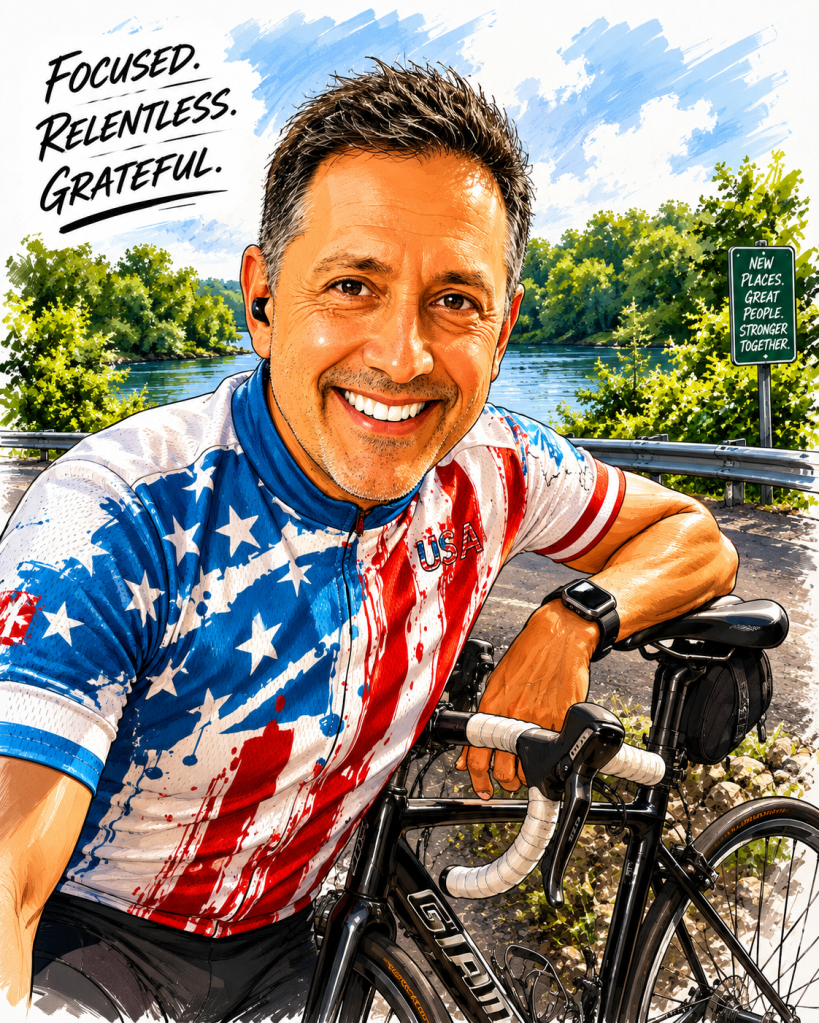
I’m trying to have a little fun with Chat GPT’s caricature creation.
I’ve always been a runner.
For years, running was my reset button. It challenged me physically, cleared my head and gave me an outlet for stress. There was something wonderfully simple about it. Put on your shoes, head out the door and go.
Then, after three knee surgeries, my doctor gave me the news I didn’t want to hear.
No more running.
So what was left for cardio? The StairMaster? Elliptical machine? Walking?
All good forms of exercise. All sounded incredibly boring to me.
A few colleagues of mine cycled, but as a “runner,” I was skeptical. I had convinced myself that nothing could challenge me as much, make me sweat as much or leave me feeling as physically spent as a solid run.
Even my surgeon suggested cycling.
So there I was in June 2020, with COVID in full swing, walking into a local bike shop knowing absolutely nothing about bikes.
Road bikes. Gravel bikes. Carbon frames. Aluminum frames. Components. Gears. Price points that seemed to range from reasonable to “you want how much for a bicycle?”
It was intimidating.
Fortunately, the owner was incredibly gracious with his time and patience. He eventually guided me toward a road bike that was a step above entry level but still had an aluminum frame.
His advice was simple: Don’t get caught up in the cool-kid swirl of carbon frames and expensive equipment until you’ve ridden for a while and know you actually like it.
Good advice.
I bought the bike and got out on the road.
Looking back, it was easily one of the top five decisions I’ve made in my life.
It Started as Exercise. It Became Something Else.
I originally started riding to replace running.
What I discovered was something much bigger.
The freedom of riding. The wind. The resistance. The fresh air. The physical exertion. There’s something about the combination that invigorates me.
Over time, cycling became more than exercise. It became a total health habit for me — physically, mentally and, in many ways, spiritually.
Different strokes for different folks. I’m not suggesting everyone needs to buy a bike and start riding 25 miles.
But I do believe everyone needs to find their thing.
For me, cycling lifts my soul.
It gives me time to ponder, ideate, reflect, recharge and simply be present.
There is nothing quite like riding along the river in the quiet of the morning. No cars. Barely another person around. Six in the morning is my favorite time to ride — before the crazies get on the road.
My average outdoor ride these days is about 27 miles. My longest has been 50.
That means I regularly get two, three and sometimes four hours largely alone with my thoughts.
In today’s world, that is a gift.
Solitude Is Underrated
We spend much of our lives consuming information.
Emails. Texts. Meetings. Teams calls. News. Social media. Podcasts. Presentations. Dashboards.
Something is always coming at us.
But when do we actually have time to think?
Some of my best ideas have come to me on a bike.
Ideas for new sales plays. Articles I want to write. Problems I’ve been wrestling with at work. Conversations I need to have. Decisions I need to make.
Sometimes I solve something.
Sometimes I realize I’ve been thinking about something entirely wrong.
And sometimes nothing happens at all.
That may be the most important part.
There is value in giving your mind enough quiet that it doesn’t have to produce anything.
The Bike Has Taught Me About Myself, Too
There are stretches of a ride when everything feels effortless.
And then there are climbs.
Your legs start burning. Your heart rate rises. Your breathing gets shorter. Your brain starts negotiating with you.
Slow down.
Back off.
Maybe today isn’t the day.
Those moments have taught me something about how I respond to discomfort.
I’ve learned that I can push considerably further than my mind initially tells me. I’ve learned how changing my breathing under physical stress can calm both my body and my thoughts. I’ve learned the difference between genuine physical limits and the limits we sometimes manufacture in our own heads.
Those lessons don’t stay on the bike.
They show up in business, leadership and life.
Energy Changes How We Lead
I have always been a firm believer in fitness.
Not because everyone needs six-pack abs, run marathons or ride 50 miles.
Fitness matters because energy matters.
Our physical condition affects how we show up.
It affects our patience. Our confidence. Our resilience. Our ability to concentrate. Our ability to manage stress. And, ultimately, our ability to make good decisions.
It’s difficult to separate the mind from the body and the body from the spirit. They are connected.
When one is neglected long enough, the others eventually feel it.
And leadership requires energy.
The energy to remain engaged late in the day. The energy to listen instead of simply react. The emotional energy to deal with difficult people and difficult situations. The mental energy to distinguish the urgent from the important.
Good decision-making doesn’t only require intelligence.
It requires clarity.
And clarity is difficult to find when we are physically exhausted, mentally overloaded and never alone with our thoughts.
Find Your Ride
Cycling started because my knees took running away from me.
At the time, that felt like losing something I loved.
Instead, it forced me to discover something I probably never would have tried otherwise.
Today, when I head out early in the morning, I’m not trying to outrun anyone. I’m not chasing a podium. Most of the time, I’m not even chasing a personal record.
I’m chasing something much more valuable.
Energy.
Clarity.
Perspective.
And a few quiet miles where nobody needs anything from me.
We spend enormous amounts of time trying to become better executives, better leaders, better decision-makers, better spouses, better parents and better people. We read books, attend meetings, study data and seek advice.
All of that matters.
But sometimes becoming better at everything we do begins with taking better care of the person doing it.
Find the thing that challenges your body, quiets your mind and restores your spirit.
For me, it happens to have two wheels.
And some of the best decisions I make aren’t made sitting behind a desk.
They’re made somewhere around mile 20, with tired legs, a clear head and nothing in front of me but the road.

