
Enough With The Spam! Get Permission to Market.

Permission

Tired of SPAM?  I’m not talking about the the stuff in the can that comes from the great state of Minnesota.  No.  I’m talking about the massive amounts of content that continues to be pushed down our throats via direct mail, email, advertisements, billboards and all the other various forms and mediums of media.

The vast majority of all incoming marketing messaging we receive is forced upon us.  We didn’t ask for it.  We didn’t invite it. We don’t want it.  And we especially don’t want all those pesky calls that come throughout the day from those companies who feel they have won the right to interrupt us with their message.  You know those calls.  The ones where you answer your phone and there’s a pause while the phone system uploads the call to the salesperson on the other end.  UGH!

Why do companies continue to take this approach to telling, and selling, their buyers?  The truth is that it’s comfortable.  It’s what they’ve always done.  It’s what your boss demands.  There is math that supports an ROI – make this many calls and you’ll get this many deals.  The other side of that same equation that is never considered, is how many potential buyers have you pissed off forever given this arrogant approach?

Permission based marketing takes time.  It’s a relationship.  Imagine walking up to a woman and saying “hurry up, we need to get married right now”, or bumping into that guy you see at the coffeeshop each day and saying “I see you here everyday, you should buy me my coffee today”.  Relationships don’t work that way.  Okay.  Maybe sometimes they do, but by and large, most lasting relationships take time.  Trust.  A commitment on each side.  Yet because approaches like these work sometimes many companies feel that if they do this often enough they’ll win with volume.

Asking for permission seems almost as uncomfortable, if not more so, than asking for the sale.  Can I talk to you?  Can I share my thoughts with you?  Can I connect with you over time to get to know you?  These are the questions you should be asking.  But to ask those questions you need to have something of value to offer.  Why do you want to talk to me, or why should I let you talk to me?  Your response should be clear, concise and focused.  You’re not about selling as much as you are about sharing.  But again, sharing takes time.  It takes patience.  It takes trust.

Think about approaching your prospects to gain their permission rather than the sale. Of course you’ll need great content, time, and most of all a genuine belief that you’re helping your customer.  Yes, it sure is a mind shift; and not one that is easily adapted.  Yet as the number of voices in the marketplace continue to increase, all fighting for shelf space with each prospect, it becomes crucial to win the hearts and minds of these prospects by gaining their permission.  Being, acting, looking, and sounding like your competition only helps your prospect weed you out quicker.  Provide value, in a safe and easy environment for which your prospect can consume it and get to know you and you’re on the path to increased revenue.

3 Hints to Help You Hit Your Goals in 2016: Hint #3 – Tell People

Goals

In my previous two blogs I wrote about the power of visualization, and the importance of writing down your goals with as much detail as possible.  You spent time thinking about your goal, what it looks like and feels like.  You captured those details on paper and keep it somewhere visible where you can see it daily.  Now you’re ready for the third, and perhaps the most difficult hint in helping you reach your goals.  Tell people!

Fear is undoubtedly the biggest driver for why we don’t achieve our goals.  Be it the fear of failure, the fear of getting started and not finishing, the fear of embarrassment, or the fear of having to ask for help, fear is the #1 reason people don’t accomplish their goals.

All of these fears are based upon our desire to fit in, to be accepted, to be normal.  As such we crave average.  Don’t shoot too high but don’t aim too low.  That’s the thinking of average.  Once we declare our goal publicly we’re now on the hook.  We’re staring that fear straight down.  We’re saying to the world “I will do this”, not try, not attempt, not hope to…but will.

Courage is perhaps the single greatest trait of successful people.  The courage to believe so deeply in yourself that even if you fail, you know you’re not a failure.  That same courage allows you to not be afraid to go after your dreams and accomplish your goals.  Courage enables you to tell the world exactly what you’re going to do.  This isn’t easy stuff.  But then again, nothing worth accomplishing is easy.

The fact is that most people are fearful of declaring their goals.  They immediately get bogged down by the “what ifs”.  They haven’t even given themselves a chance to start before they begin to identify all the obstacles and reasons why they’ll never do it, never make it, never get it, never reach it.

Surrounding yourself with the right people is crucial to your success. Your network should be filled with people who encourage you to go for the gold.  No one ever sets out to win bronze.  Tell your friends, your peers, your mentors exactly what your goal is.  Tell them when you’re going to reach it.  Make a declaration.  Write that down too.

Doing these 3 things will help you reach your goals, not just in 2016, but well beyond.

3 Hints to Help You Hit Your Goals in 2016: Hint #2 – Write it Down

Goals

In my previous blog, 3 Hints to Help You Hit Your Goals in 2016 ,I wrote about the power of visualization; having a crystal clear mental picture of exactly what you’re trying to achieve.

Hint #2 for helping you hit your goals is to write them down.  There’s something about committing goals to paper that transform a goal to a mandate.  Imagine if the Constitution was never written down and signed, or the Ten Commandments, or a speed limit sign.  When our brains see something in writing we see it more as a rule, a definite, a conclusion.

After you’ve visualized your goal take the time to write it down.  Include as many details as you can.  All the things your brain saw when you visualized the goal should be captured on paper.  Be specific.  Include pictures where possible.  If it’s a new home, find a picture of a house you’d love to own, cut it out, and keep it with your written goals.  If it’s a trip to Iceland, find a picture of Iceland and include it with your written goals.

Make sure your written goals are visible.  Don’t write them down and put them in a drawer somewhere.  Keep them out and in front of you.  Your nightstand, your desk, the refrigerator.  Remember, your subconscious brain will continue to work overtime on bridging the gap between your current reality and the goal you’ve set.  The more you review that goal the harder your brain will work to reach it.

Stay tuned for Hint #3 on Friday.

3 Hints to Help You Hit Your Goals in 2016: Hint #1 – Visualization

Goals

We all know goals are an important part of success.  Whether our objective is personal or professional, having a goal provides us with a “thing” to focus on to achieve that objective.

Over the years I have found 3 actions that have improved my ability to reach my goals.  I’ll share my hints this week.  Today, my first hint is visualization.

Visualization is a powerful way to gain clarity of your goal.  What is it you really want?  Can you see it?  What does it look like?

When I was younger I had a poster in my room with a picture of a mountain range in Arizona.  I was mesmerized by that picture and promised myself that one day I would live near the mountains.  And while I never got to Arizona I did move, and live in Reno, Nevada for two years at the base of the Sierra Nevada’s.  A goal achieved.

So what goal are you striving for in 2016? Is it a new house?  A new car?  A specific weight you’re trying to reach?  A book you’re trying to write?  A new job? A vacation? Bungee jumping?  Taking up a new sport or activity?

Find a quiet place to think.  Close your eyes and visualize exactly what the goal is you’re going after.  What does it look like?  Be as specific as possible.  Where is it?  What color is it?  How does it look?  What will you be feeling when you reach the goal; your emotions? When will you reach it? What’s the timeframe?

The more detail you can place around your goal through visualization the more likely you’ll be able to achieve it.  In his book The Success Principles, author Jack Canfield talks about how visualization activates the subconscious mind.  The more you visualize your goal the more your subconscious mind works to bridge the gap between your current reality and the goal you’re focused on.  He goes on to say, “Your creative subconscious can only think in pictures, not words.”  Having a clear picture, a visual, of the goal you’re trying to achieve is the first step to successfully achieving that goal.

Stay tuned for Wednesday’s second hint on improving your success in reaching your goals.


A Brief Reflection on 2015

As I look back upon 2015 there is one word that captures my emotions for the year…blessed.  This year was a great year in so many different ways. As I reflect on this past year, I am once again overwhelmed by how fortunate, and blessed, I am to have so many wonderful people in my life.  

I am grateful for the opportunities I had in 2015 to coach and develop some great leaders.  I am so excited to have the pleasure and honor to be a part of their personal and professional growth…you know who you are.  Throughout the year I was also blessed to have been the recipient of some great coaching from a handful of mentors, many of whom are past bosses…you too know who you are.  My leadership, strategy, decision making, and critical thinking skills continue to evolve and develop in large part due to your coaching.  Thank you.

In 2015 I had the privilege of leading yet another complete rebranding effort, dusting off a tired brand and creating a brand with life, energy, and excitement. I led a team through the deep and exciting work of the Buyers Journey that enabled us to adjust our go-to-market strategy in order to better align with the way our buyers make their decisions. I directed the launch of an Inside Sales team that proved our hypothesis that channel sales – specifically through influncers – can be as successful with an inside sales team as a field sales organization…and done at a lower cost of sale.  I worked with some pretty terrific partners to create some great content for customers and prospects alike, that fueled a demand creation strategy anchored by some great marketing automation tools. It was a highly productive year.

On a personal note, I published my 135th blog and reached 4,000 visitors to this site in the two years since its launch.  I am thankful for all those who follow me, read what I write, share it, comment, and like it.  Your interest inspires me to continue with this life-long passion of mine. I’m setting my sights on reaching 10,000 visitors so keep your comments coming as to the types of content you like reading about and sharing.  Thank you so much for your support.  

Last but not least I want to thank my wife Terri whose support and counsel has been a constant for 26 years.  I couldn’t imagine being on this journey without her.  And to my two kids who continue to show me the power of having goals and dreams, you not only keep me young but inspire me to keep growing.  You’re simply the best.

As we enter this new year I wish you all a healthy, happy, and prosperous 2016!

Leadership Is About Acting Now


Don’t put off until tomorrow what you could do today.  In Seth Godin’s book Linchpin, he says, “late is the first step to not finishing.” Many suffer from analysis paralysis.  Trying hard to solve for perfection.  Trying hard to not make a mistake.  Leaders however think about decision making differently.  They have the  courage to act and the confidence to own their decision no matter the outcome.

I might, turns into I can.  Leaders say I will, instead of I could.  I may, becomes I must.  I should, changes to I am.  Leaders think in the here and now.  They understand the importance of being decisive and accountable.  They look to the future with a clear understanding of their current circumstances.  Leaders are well-rounded.  They are continuous learners, who through learning, are constantly challenging their own perspectives, ideas and opinions.  Leaders are not afraid to change tact given new information.  They are more concerned about getting it right than being right.

In his book Who Says Elephants Can’t Dance, Lou Gerstner conveys a philosophy of “sooner is better than perfect.”  Doing things sooner often times requires getting comfortable with uncertainty.  The point being, once you have taken action you can always do a course correction.  Leaders are constantly acting.  They are in perpetual motion.  They’re never sedentary or static.  They’re fluid, dynamic, evolving.  

Leaders know that every journey begins with the first step.  Sometimes the step is in the wrong direction.  That’s okay.  They’re comfortable with change.  They’re confident in the midst of ambiguity.  They thrive on the thrill of what they can learn.  They’re curious.  They’re bold.

Be curious.  If being curious is too bold of a starting point then be cautiously curious.  Strive to become comfortable with being uncomfortable.  But act.  Taking action provides  the leader with learnings.  Those learnings add to the leaders inventory of skills, experience and perspectives.  With those ingredients the leader is able to garner the followers they need to successfully execute on their vision.

Keep moving.  Keep making things happen.

How Happy Are Your Employees?  Find Out in 3 Easy Steps.


Turnover. Theft. Sick time.  These are just a few ways poor morale manifests itself in the workplace.  Data shows that most employees leave a boss not a job.  Data also shows that stealing office supplies is actually less costly to the company that stolen time. Water cooler talk, extra long lunches, and lengthy hallway conversations are examples of stolen company time.  There’s a difference between hallway conversations that foster collaboration versus those that fuel the rumor mill.  But how do you, or can you – the boss – tell the difference?

Some companies spend thousands of dollars to survey and test for employee morale.  From an informal Survey Monkey to much more formal nationally recognized surveys, companies try to measure the engagement level of their employees on an ongoing basis.  What’s important to note is that these are only tools.  Best case they are a snapshot in time.  Worst case they are the result of highly skeptical employees providing the responses they think “big brother” is expecting.  Truth be told – and a truth many companies don’t want to acknowledge – is that most employees are highly suspicious of these “confidential surveys”.  I’ve worked in more than half a dozen firms where these survey’s were used and employee sentiment is generally the same everywhere.  This means that the results produced by these surveys are potentially flawed.  It also suggests to employees that it’s easier for management to send a survey rather than engaging them directly.  

If you really want to know what’s happening in your business be courageous and try doing these 3 things:

  1. Skip Level Meetings.  These are meetings where the boss meets with employees one ot two levels down in the reporting structure.  These meetings are meant to be informal.  The goal is to establish trust and to work to let the employee know how much the leader cares about them and their team’s morale.  
  2. Town Hall Lunch & Learns.  Keep groups small, no larger than 20 employees.  The speaking executive or manager should present a short “State of the Union.”  At the end of the presentation turn it over to the employees for questions.  If there are no questions the executive should work to engage the audience by asking for their opinions and why they feel the way they do.
  3. Management by Walking Around.  Abraham Lincoln was perhaps the first leader to practice this tactic.  It provides the leader with direct insight into the day-to-day workings of a business.  It also allows the leader to be seen as engaged and “in the fight” alongside their employees.

Whether you decide to try one, or all three, the key is to be authentic.  Employees know when you’re running through the motions.  They can spot inauthentic leaders a mile a way.  If you really don’t care, nor are willing to take action to address concerns you may hear, you’re better off not doing any of these things.  Of course if that’s the case you already know just how unhappy your employees already are. Remember they’re only modeling what they see from their leaders.  Care deeply, act deliberately.  

Forget Company Culture and Focus on Chemistry

chemistry

In a recent blog post titled Can You Tell if Your Culture Is Broken?, I shared some insights on how someone inside a company could recognize a breakdown in their company’s culture. That disconnect between what you say you are, versus what you really are; the old, perception-versus-reality dilemma.  And yet for all the hype given to the importance of “culture” why is it there are so many mismatches between employees and employers?  The reason is due to the lack of chemistry, not culture.

You work with people not an organism.

We’re all different. We have different backgrounds, different experiences, likes, dislikes, and preferences.  Each of us have our own unique personalities.  What excites and interests me, may be totally boring to you.  Things that scare me might energize or thrill you. That’s what makes the world go around.

Yet it’s so commonplace to find signs on company walls, or pages on company websites dedicated to touting its culture.  Or better yet, how many of you have seen the big screen TVs in lobby areas that state the mission, vision and value statements of the company?  Some companies go to extreme lengths to tell the world how wonderful they are. But saying so doesn’t make it so.  People make up a culture.  A culture is a living breathing thing, made up of individual personalities. It’s not static.  It’s not permanent.  It evolves. It’s people.

In Doris Kearns book Team of Rivals, she talks about how Abraham Lincoln surrounded himself with a variety of individuals.  Many, if not most, were opposed to Lincoln’s thinking on slavery, the war, and exactly how much power he had as President over the states.  While I’m not a betting man, if I were to be, I would have bet against Lincoln’s experiment working.  Then again, I would have completely underestimated his leadership abilities to bring people together and accomplish great things.  The challenge of course was one of chemistry.  How do you put together so many different personalities and get them to jell…to be effective working together?  The answer is leadership.

Whether you’re assessing the chemistry between you and your boss, your peers, or the team that supports you, pay close attention to your intuition.  How do you feel when you’re connecting or interacting with them?  Does it feel natural?  Forced?  Valuable?  Do you feel like you can accomplish anything working with them, or do you feel as if nothing will work, nothing will be good enough?  Is that little voice saying “you’re so lucky to be here”, or “keep a keen eye open”?

No matter what the sign says in the lobby, or how many values your company posts on its website, it all comes down to chemistry.  Can you jell?  Chances are you won’t struggle to get along with Integrity, Innovation, and Accountability.  Instead your challenge will be with Jack, Jill, and Jane Doe. Take the time to acknowledge your intuition.  We were all given the hairs on the back of our necks for a reason.  It’s not about optimism or pessimism.  It’s about being pragmatic.  Recognizing your reality and taking the appropriate action.

Keep your focus on people.  Forget about the sign on the wall.


A Remarkable Sales Lesson From Yankee Candle

Candle

Yesterday I went into Yankee Candle to purchase some of their awesome selling Balsam and Cedar scented candles.  I had a Buy Two, Get Two Free coupon.  My goal, as always when shopping, is to know exactly what I want, get in, get out, and get home!  I certainly hadn’t expected to get schooled in Sales while buying something as simple as a candle.  But I did.

Immediately upon walking in I was greeted by a very nice, “in-the-Christmas-spirit” sales associate.  She noticed I was a “man on a mission”, and asked what she could do to direct me to what I was looking for.  I told her I had a coupon for the buy 2, get 2 and I specifically wanted Balsam and Cedar candles.  She directed me to “get a basket” and then led me to the display where she then said “you want to buy the large candles with that coupon.”  I told her I was planning on getting the medium size jars.  What she said next hit me like a brick.  In all my sales career this was a first.  Her response was so quick, and so filled with conviction it just completely disarmed me.

She said, “Look…you went to college.  The large jar is $27.99 and the medium is $24.99 but the burn-time difference is 60 hours.  I know you can do the math.”  WOW!  This lady was spot on.  She used my own intelligence against me!  I did go to college and I could do the math.  With that I said yes, and out I walked with 3 Balsam and Cedar candles and a Mountain Lodge (my favorite) for a bit of variety.

On my drive home this experience got me thinking.  This lady’s style and level or persuasion rivaled any C-Suite sales executive I’ve ever dealt with and she was working for Yankee Candle!  While I might be wrong, I’m betting her sales skills were all her and not taught by Yankee.  If I’m incorrect I’d love to know more about their sales training program.

Yankee Candle Lady’s Sales Style:

  1. Smile.  The entire interaction she was smiling and genuinely cheerful.
  2. Recognize and acknowledge body language – “man on a mission”.
  3. Provide subtle direction – “get a basket”.  She’s in control.
  4. Respond accordingly – “follow me”, as she led me to the display.
  5. Know your product and your price points – “you want to buy the large”.
  6. Ready with quick reply to objection – “You went to college…you can do the math”.  Her response is disarming.  She’s challenging my intellect but subtly…and with a smile.
  7. Close the deal – she walks me up to the counter to be cashed out.
  8. Thanks me for coming in.  I wish her a Merry Christmas and she looks at me, still smiling and says “Merry Christmas to you too”.

What a truly unexpected and wonderful experience buying a candle!  Yankee, you’ve got yourself a Raving Fan! What do you think?

Why Empathy is Important for Sales Leaders

Empathy

Sales is tough.  Rewarding but tough.  Not every one is cut out for a career in Sales.  It’s the ultimate “what have you done for me lately” profession.  This year’s top performer is next year’s runner-up.  Being a salesperson requires high energy, discipline, tenacity and focus.  Great sales people possess the ability to visualize their success.  They can see themselves on the stage receiving The President’s Award, or cashing that big bonus check.  They’re high achievers, hard workers, and by and large, emotionally charged people.  Great sales leader have many similarities. But the really great leaders have more empathy than your average sales leaders.

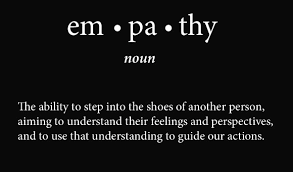
Empathy allows you to connect.  It makes you human.  Empathy allows you to feel, or perhaps more pointedly, allows you to understand how the someone else feels.  Having empathy is different from having sympathy.  Many people feel they are the same.  They’re not.  They’re wildly different.  Sympathy is about compassion, “feeling sorry for”, whereas empathy is being able to relate to another person.

Great sales leaders can relate, or empathize, with how challenging it is to find good prospects.  They can empathize with how exhausting making 100 dials a day can be.  If it were sympathy, I’d be saying “I’m sorry you have to make those 100 calls today…I sympathize for you.”  But that’s not the case.  The goal of a great sales leader is to have their team know, that they know, what it’s like to walk in their shoes.  The team wants to know the leader has “been there, done that.”  Great sales leaders are able to demonstrate empathy without effort because they can simply relate.  They’ve carried the bag, they’ve suffered the rejections, they’ve ended their day emotionally and physically exhausted without a sale in hand.  They’ve lived it.

Great leaders are not scared or intimidated to show empathy.  They don’t see it as a weakness to say “I went an entire week once not selling a thing”.  They’re not excusing low or poor performance by providing sympathy.  In fact, instead, what they are saying is I’ve had some moments like that myself and here’s how I pulled myself up and turned the corner.

We’re emotional beings.  Period.  We want to know we connect.  We’re pack animals.  Knowing we’re understood is critical.  Top performers, no matter what the profession, just want to be understood.  They don’t want sympathy and they don’t want anyone to “cut them slack”.  They want encouragement.  Not cheerleading.  There’s a difference.  Encouragement provides direction, a path.  Cheerleading provides nothing but a temporary high.

If you want to supercharge your leadership focus on developing your own personal level of empathy.  How do you relate to others?  What do you say to people who are struggling?  If you can improve your empathy skills you can improve your results, and the results of those around you.  Now you’ve created two wins.  Now you have momentum that will carry you and your team forward, and that’s what it’s all about.