Curiosity: The Key to Great Sales Talent


1b5805f16464a44669a42520558dc6ca

Is it really possible to hire great sales talent?  What makes one sales person succeed and another fail?  How does one sales person out-produce another, or an entire team?  Is there a secret trait, or characteristic, you should know about?  Average turnover in Sales ranges from 35 – 60% annually.  I’m aware of some companies where turnover is even higher, hovering in excess of 70%.  Imagine a sales force where 7 in 10 will be gone within the first 12 months.  Not a pretty picture.

If you’re building a sales team there are two traits that I have found to serve as a good barometer of future sales success; curiosity and the desire to learn.

Sales people must be curious. They should enjoy tinkering with things.  Changing things up.  Trying new things.  Asking tons of questions.  They should show a spark when presented with a problem, not shy away and become quiet.  Being curious allows a successful sales person to better understand their customers needs, the marketplace, trends, and possibilities.

The second trait that is a reliable predictor of sales success is the desire to learn.  Notice I didn’t say ability to learn.  We all have abilities…some natural, some taught.  However, what we really need is desire.  Desire speaks to what an individual will do regardless of what’s required.  If the desire is strong enough she will move mountains to accomplish what’s in her sites.

So how can you probe for curiosity and desire?  Here are some questions to ask during the interview process that will provide you insight on whether your candidate has these traits:

  1.  What would you do if you knew you wouldn’t fail at it?
  2. What was the last book you read? What did you learn?
  3. What LinkedIn groups do you belong to, and tell me about a discussion within that group that you found to be interesting and why?
  4. What types of books do you like to read and why?
  5. Who is your favorite author? Why?
  6. If you could start your own business what would it be and why?
  7. Who would you pick as your favorite leader and why?
  8. What is your preferred method of learning?
  9. What 3 adjectives would a client, or former colleague use to describe you?
  10. Tell me your 3 favorite questions to ask prospects
  11. What would you do if you won the lottery?

Selling requires strong critical thinking skills.  Critical thinking skills are developed  by expanding your insights and perspectives which happen primarily through learning.  The more curious someone is, the greater their propensity will be to be a continuous learner.

Let me know what you think.  Happy recruiting!

A Remarkable Sales Lesson From Yankee Candle

Candle

Yesterday I went into Yankee Candle to purchase some of their awesome selling Balsam and Cedar scented candles.  I had a Buy Two, Get Two Free coupon.  My goal, as always when shopping, is to know exactly what I want, get in, get out, and get home!  I certainly hadn’t expected to get schooled in Sales while buying something as simple as a candle.  But I did.

Immediately upon walking in I was greeted by a very nice, “in-the-Christmas-spirit” sales associate.  She noticed I was a “man on a mission”, and asked what she could do to direct me to what I was looking for.  I told her I had a coupon for the buy 2, get 2 and I specifically wanted Balsam and Cedar candles.  She directed me to “get a basket” and then led me to the display where she then said “you want to buy the large candles with that coupon.”  I told her I was planning on getting the medium size jars.  What she said next hit me like a brick.  In all my sales career this was a first.  Her response was so quick, and so filled with conviction it just completely disarmed me.

She said, “Look…you went to college.  The large jar is $27.99 and the medium is $24.99 but the burn-time difference is 60 hours.  I know you can do the math.”  WOW!  This lady was spot on.  She used my own intelligence against me!  I did go to college and I could do the math.  With that I said yes, and out I walked with 3 Balsam and Cedar candles and a Mountain Lodge (my favorite) for a bit of variety.

On my drive home this experience got me thinking.  This lady’s style and level or persuasion rivaled any C-Suite sales executive I’ve ever dealt with and she was working for Yankee Candle!  While I might be wrong, I’m betting her sales skills were all her and not taught by Yankee.  If I’m incorrect I’d love to know more about their sales training program.

Yankee Candle Lady’s Sales Style:

  1. Smile.  The entire interaction she was smiling and genuinely cheerful.
  2. Recognize and acknowledge body language – “man on a mission”.
  3. Provide subtle direction – “get a basket”.  She’s in control.
  4. Respond accordingly – “follow me”, as she led me to the display.
  5. Know your product and your price points – “you want to buy the large”.
  6. Ready with quick reply to objection – “You went to college…you can do the math”.  Her response is disarming.  She’s challenging my intellect but subtly…and with a smile.
  7. Close the deal – she walks me up to the counter to be cashed out.
  8. Thanks me for coming in.  I wish her a Merry Christmas and she looks at me, still smiling and says “Merry Christmas to you too”.

What a truly unexpected and wonderful experience buying a candle!  Yankee, you’ve got yourself a Raving Fan! What do you think?

Why Empathy is Important for Sales Leaders

Empathy

Sales is tough.  Rewarding but tough.  Not every one is cut out for a career in Sales.  It’s the ultimate “what have you done for me lately” profession.  This year’s top performer is next year’s runner-up.  Being a salesperson requires high energy, discipline, tenacity and focus.  Great sales people possess the ability to visualize their success.  They can see themselves on the stage receiving The President’s Award, or cashing that big bonus check.  They’re high achievers, hard workers, and by and large, emotionally charged people.  Great sales leader have many similarities. But the really great leaders have more empathy than your average sales leaders.

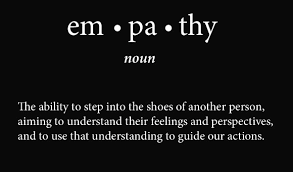
Empathy allows you to connect.  It makes you human.  Empathy allows you to feel, or perhaps more pointedly, allows you to understand how the someone else feels.  Having empathy is different from having sympathy.  Many people feel they are the same.  They’re not.  They’re wildly different.  Sympathy is about compassion, “feeling sorry for”, whereas empathy is being able to relate to another person.

Great sales leaders can relate, or empathize, with how challenging it is to find good prospects.  They can empathize with how exhausting making 100 dials a day can be.  If it were sympathy, I’d be saying “I’m sorry you have to make those 100 calls today…I sympathize for you.”  But that’s not the case.  The goal of a great sales leader is to have their team know, that they know, what it’s like to walk in their shoes.  The team wants to know the leader has “been there, done that.”  Great sales leaders are able to demonstrate empathy without effort because they can simply relate.  They’ve carried the bag, they’ve suffered the rejections, they’ve ended their day emotionally and physically exhausted without a sale in hand.  They’ve lived it.

Great leaders are not scared or intimidated to show empathy.  They don’t see it as a weakness to say “I went an entire week once not selling a thing”.  They’re not excusing low or poor performance by providing sympathy.  In fact, instead, what they are saying is I’ve had some moments like that myself and here’s how I pulled myself up and turned the corner.

We’re emotional beings.  Period.  We want to know we connect.  We’re pack animals.  Knowing we’re understood is critical.  Top performers, no matter what the profession, just want to be understood.  They don’t want sympathy and they don’t want anyone to “cut them slack”.  They want encouragement.  Not cheerleading.  There’s a difference.  Encouragement provides direction, a path.  Cheerleading provides nothing but a temporary high.

If you want to supercharge your leadership focus on developing your own personal level of empathy.  How do you relate to others?  What do you say to people who are struggling?  If you can improve your empathy skills you can improve your results, and the results of those around you.  Now you’ve created two wins.  Now you have momentum that will carry you and your team forward, and that’s what it’s all about.


Salespeople BEWARE: You’re About to be Sensored

ScaredSalesPerson

So you’ve chosen a career in Sales.  You’re excited by the thrill of the hunt, the change of scenery everyday and the opportunity to make as much money as you want. But could Sales be changing in a way that makes all this a distant memory?  You may be at risk of being replaced by a sensor…big data.

In a recent Fortune magazine article on Formula 1 racing authored by Stacey Higginbotham, she writes about how big data has changed the racing sport.  In “less than 300 milliseconds” data can travel from the farthest track in Australia to the UK where it can be analyzed and strategy adjustments can be provided back to the crew at the racetrack.   According to Alan Peasland, head of technical partnerships at Infiniti Red Bull Racing, “Gut-feel decisions just aren’t made.”

Imagine big data eliminating gut-feel decisions in your sales process.  With CRM platforms, marketing automation systems, and a variety of sales enablement tools there is more data than ever providing insight into each sales encounter.  When contact was made, what was discussed, who was present, what the outcome or next step is, or what went wrong.  Crunching all this data and putting it into a useable format might just make the salesperson a thing of the past.

As baby-boomers are overtaken by millennials buying habits are changing quickly.  Millennials rely on mobile devices and testimonials much more than boomers do.  In fact, according to Business Insider, 62% of millennials respond to mobile offers versus 39% of boomers.  Additionally, 82% of millennials favor word-of-mouth from friends and family versus 52% of boomers.  That means marketers must adjust their branding, advertising and sales processes.

Is it possible that in the future the role of the salesperson simply goes away?  What if a company like Amazon was able to aggregate all of your purchases and with great accuracy recommend and predict future consumption…both product type and quantity?  Wait a minute…aren’t they already headed that way?  The Dollar Shave Club is already doing this with great success. Maybe this isn’t as far-fetched as you’d like to think it is.

Sales professionals need to recognize this tectonic shift.  Your ability to survive being replaced by a sensor collecting and analyzing data will only be as good as your capability to adapt and add value.  Reading, researching, and having your own teachable point of view are critical requirements of your survival.  In the absence of any or all of these requirements your sales role today will become a fossil for tomorrow.  Get curious and keep thirsty for new knowledge.

3 Ways to a Strong Sales Finish

JoePic

With 75 days left in the calendar year many salespeople find themselves in a crunch.  Either a crunch to hit that next multiplier level for bonus money, or a crunch to simply get as close to plan as possible.  Regardless of where you fall in that spectrum here are 3 things every sales pro should be doing right now:

  1. 70/30 split.  At least 70% of your time should be spent with your current customers.  You should be focused on understanding their business, providing value by educating them on possible solutions for their needs, and listening for trends, concerns, ideas, etc.
  2. Ask for the business.  The closest thing to a silver bullet in Sales is asking for the business.  Sure, you need to have earned the right to ask, but let’s assume you have.  Too often sales people assume that if the customer had more business they would have already given it to them.  WRONG!  WRONG!  WRONG!  It’s not their job to give you anything.  It’s your job to earn it, ask for it, and then deliver it in a way that makes you both memorable and remarkable.
  3. Be disciplined.  There’s no such thing as a 9 – 5 sales job.  If those are the hours you’re working you’re simply not doing enough.  Oh…you’re already at quota working 9 – 5?  Then I’d ask how much more you could have sold if you kicked it up a few notches?  It’s time to push.  Even if you’re at quota now a new sales year is right around the corner.  Plan your days.  Have your call list ready the night before.  Don’t waste precious selling time getting ready.  When you’re standing at the starting line it’s too late to train for the race.

Be sure you’re confronting reality.  If you’ve missed plan this year take an inventory of where things went wrong.  Be honest.  At the end of the day if you’re over plan it’s because of you and if you’re under plan the reason is the same…you.  You may be more expensive, of lesser quality, or longer to fulfill.  Regardless, you own finding a new path.  Once you accept accountability the path becomes much clearer.

Be calm.  Sell on.

4 Keys To a Better S.A.L.E.

Improve

No matter if you’re new to sales or a seasoned sales executive, brushing up on your selling skills is as important as changing the oil in your car regularly.  Leave the oil too long without changing it and your engine gunks up, gas mileage deteriorates, and in time your engine will fail.  Knowledge is to the sales person what oil is to an engine.  When you stop feeding your mind new knowledge your performance deteriorates and failure is around the corner.  But with so many things to think about, so many calls to make, numbers to hit, you don’t know what to focus on first.  So here’s a tip that will keep it simple…just remember SALE.

The “S” in Sale stands for structure.  Every sales person needs structure.  Some people are naturally disciplined and have strong internal structure while others require help to remain focused and disciplined.  Only you can be honest enough with yourself to know where you fall on the structure spectrum.  Structure includes when you make your calls, how your desk is set up, and whether your car is cleaned.  Structure speaks to your ability to organize.  Stronger organization equals higher efficiency which yields better results.

The “A” in Sale stands for attitude.  John Maxwell, the famous inspirational author, wrote “your attitude determines your altitude.”  Having a positive attitude is essential to success in life and critical to your success in Sales.  Have you ever met a sales person who seemed like they were on their last leg?  No more gas in their tank?  How did that make you feel?  Excited to buy?  Confident in purchasing their product…from them?  No.  No one wants to work with someone with a poor attitude.  No one buys from someone who lacks confidence in themselves, their product, or their company.  If you’re honest enough to recognize you have a confidence gap – read.  Thousands of books and books-on-tape are out their that can help.  Take action.  Don’t let another day go by with a bad attitude.

The “L” in Sale stands for learning.  If you’re not a continuous learning become one…and fast.  Albert Einstein said, “You have to learn the rules of the game.  And then you have to play better than everyone else.”  The rules of the game are always changing in Sales.  Your customer is evolving.  The internet and its ability to provide mountains of information will continue to change the game for years to come.  Better educated customers and prospects force a sales person to constantly up their game.  If you think the sales skills that won you awards 10 years ago, 5 years ago, or even last year will work in 2016 you’re wrong.  News flash!  If your buyer hasn’t already changed, they are in the process of changing.  Read.  As much as you can from as many sources as you can.  Commit to bringing one or two points from what you read that day into your sales conversations, then watch how your customer engagements change before your eyes.

The “E” in Sale stands for energy.  And lots of it.  Sales is physically and mentally demanding.  Some days are more draining that others.  Break up your day.  No matter how good you are you simply can’t sit and make 50 sales calls in a row without stopping.  While that may be physically possible, your energy levels will diminish and your customer will sense it.  Stay hydrated.  Drink 4 – 5 glasses of water throughout the day, or bottles if more convenient.  Stop for lunch.  If you don’t have the time for lunch keep an energy and protein bar handy.  You don’t want low energy levels to come across as poor attitude.  And make sure you get a work-out in daily.  Whether you start, or end, your day running, spinning, swimming or CrossFit, simply make sure to get some exercise in.  It will help keep your mind fresh, your energy up, and your endurance strong.

Happy Selling!

Stop Selling, Start Asking: 3 Questions That Will Improve Your Results

Ask

For many companies January represents the start of a new year.  A new beginning when all numbers are at zero and the uphill climb to reach the new year’s sales quota gets under way.  And whether your company sells cars, computers, insurance, or consumer staples it’s likely its increased its goals in 2015 from the prior year, and to you that means a bigger sales quota.

How do you reach that new number when last year’s number seemed big enough?  Where will you find the time to sell more and still have a chance to see your family, hit the gym, travel a bit, or simply sleep a little?  The fact is, making more calls isn’t the answer.  The more calls you make, prospects you talk to, emails you send, or LinkedIn invites you issue won’t be enough to hit a higher quota.  You’ve got to operate differently.  You’ve got to change your approach.  The most effective way to increasing your sales results is by asking better questions…the right questions.  Start with these 3 questions below when meeting with a prospect for the first time.

  1. In looking back on your results last year did you accomplish what you hoped?  Asking this question provides insight into the prospects priorities and values.  It also offers you a glimpse into how likely they are to provide you with the critical information you’ll need to construct a proposal or recommendation that adds tangible value to their business.
  2. What are your top goals or priorities for this year?  If you don’t understand your prospect’s business you have little chance of doing business with them.  Likewise, how much time, effort, and energy is wise to spend on a prospect who doesn’t know where he or she is headed?  With limited hours in the day, and that big goal in front of you, your best chance of success lies in working with people who all have clear goals…grow revenue, reduce expenses, improve turnover, etc.
  3. How do you currently determine if you’ll buy again from one of your providers?  It’s important to know up front if the prospect makes their decisions based solely on price, service, future product improvements, or ease of use.  Whatever their criteria is in sending you more business, be sure to take note and not only build it into your proposal but more importantly deliver on that expectation.  If innovation is important to the prospect don’t promise product changes if your product hasn’t changed in years or has no planned changes on the horizon.  Once you lose trust and credibility your reputation becomes worthless.

If you’re not comfortable asking these questions there’s likely a good reason which most of the time will be due to the lack of rapport built immediately on the front end of your interaction with the prospect.  Remember, if you approach a prospect like a typical sales person their natural defenses will be up, but if you approach them as a business person who has passion around your product and deep-rooted beliefs and experiences that showcase the value of that product you’ll find your prospect will be more open, more engaging, and inclined to forge a relationship with you.  Authenticity is your key to success and its something that has to be real and heartfelt, it can’t be pretend.

The Coercive Contactor Versus the Caring Connector

Sales people have been taught the importance of the numbers. The number of dials made each day, contacts made, and presentations scheduled, are all metrics sales professionals have had baked into their thinking. You want more sales, make more dials. You want more presentations, make more contacts. We grind it out every day focused on persuading, manipulating and influencing the prospect just enough to get them to see things our way and then…BAM…a sale is made. I refer to sales people that fit this description as coercive contactors…make the contact and then through sheer force of will, or fear-selling, make the sale.

But times are changing. The buyer today is far more educated than in the past thanks in large part to the internet. Most agree that a majority of the buying process is completed before a buyer ever meets with a sales person. How did this happen and what does it mean to you as a sales person?

Google has changed our world. In a couple clicks of a mouse we can find information on virtually any topic or question that we could dream of asking. Volumes upon volumes of data and content reside on the web, there for the taking. In the comfort of our homes and offices, cars or restaurants, we have 24/7 access to all the information we could possibly need to make informed decisions.

For the typical sales person this poses a huge threat. Most of us were trained in the art of persuasion, manipulation and influence, in order to bring the pain the buyer is feeling front and center. And while shining a light on the buyers pain isn’t wrong or inappropriate, it is a less effective selling tool if the sales person doesn’t know what to do with the buyers pain once they’ve identified it. You see, buyers have a much better sense today whether your solution will actually help them. They’re no longer completely reliant upon the sales persons power of persuasion and instead draw from their own research and education as to what may improve their circumstance.

Whether it’s an outsourcing solution to improve business performance or a new medication to improve your health, just about any information you’re looking for is available via the web. As such the dependency on the sales person has evolved from a pitch person to a “caring connector”. A caring connector is how an authentic sales professional presents themselves in what they say, how they say it, what they do, and how they act. Forget about the super slick, fast talking sales dude. Today the successful sales pros are ones who take the time to listen, ask thoughtful questions, and perhaps most of all, be honest enough to tell the prospect just how helpful their solution will be. They demonstrate genuine care in how they connect with the buyer. This is a huge mind shift in sales. In fact, many recent studies conducted by Harvard Business Review, as well as, in many books authored on sales including Jeff Thull’s recent Exceptional Selling, show proof that being willing to walk away from a sale because there’s simply not enough value there, actually enables you to sell more. The premise is that once someone trusts that you have their best interest at heart, and in mind, they’ll come back to you again and again. Additionally, once you’ve determined that there is little value to the prospect to move forward with your solution you stop forcing a sale and move onto the next opportunity, again freeing your time to engage with a buyer whose needs and circumstances better align with the value you provide.

So try it. Try shifting from that coercive contactor to the caring connector and watch your sales grow.

Your Doctor May Be Your Best Sales Coach

doctor

In my previous blog post I talked about a selling strategy that helps to eliminate lost sales.  Lost due to a disconnect between the prospect and the sales person.  A communication miss fire on either end is responsible for every sale not made.  If the sales person is communicating and observing the prospects response, or reaction, there should be no last-minute surprises of lost business.  In fact, if you were really honest about it, most of the time you knew deep down that sale was going nowhere.  But the sales gods have been clear for decades that you never give up, never walk away, always be closing, and never take no for an answer.  If you’re into self-deprecation that might be exactly the approach you’re looking for.  But for those of us who are interested in transcending the age-old image of a product pusher to one of a true sales professional, looking for the “no” is how you should approach each sales opportunity.

For years I have taught and coached sales teams across a variety of different industries to approach a prospect as a doctor approaches a patient.  Curious, thoughtful, prescriptive and honest.  Here’s how:

  1. Curious.  The first thing a doctor does when he/she enters an exam room is begins asking questions.  What’s going on?  When did it start?  Is it like this, or like that?  Do the symptoms increase in intensity during certain times or are they constant and unchanging?  The doctor is beginning to diagnose your problem.  Asking questions, no matter how uncomfortable they may be, is the first step to a proper diagnosis.
  2. Thoughtful.  In my experience (and to be completely honest I believe I have the world’s greatest doctor) great doctors never provide knee jerk responses.  They go through their diagnosis phase and take a moment to process the information they’ve just gathered.  Sure this process step may take seconds, but in most cases pay attention the next time you go to the doctor and watch for that “medical processing pause”.  This refers to the time it takes for the doctor to thoughtfully provide their assessment and prescribe next steps.
  3. Prescriptive.  Depending on the assessment of what’s wrong with the patient the doctor may have one to many different prescriptions to offer the patient.  The prescription may not be solely medicine related.  A doctor may prescribe physical therapy, or eliminating a specific food from your diet.  He/she may also prescribe a mobility aid such as crutches or a walker, or even a sling or splint depending on the injury.  The point is that in many cases there are a variety of paths forward and the doctor presents these options in the form of prescriptions.
  4. Honesty.  This element of the doctor-patient relationship is the most important.  No matter how good the doctor is, if there is no trust that exists between him/her and the patient the above 3 ingredients are useless.  By the time the doctor gets to the prescription phase of the patient examine, he/she is presenting options along with their personal choice.  How many times have you heard a doctor say, “if you were my son”, or “when my mom went through this we decided to do…” The trust and honesty that exists between a doctor and patient – their ability to communicate transparently with one another – is the ingredient that results in the patient’s ability to improve their condition.

The relationship between a doctor and patient exists for one of two reasons:  to fix something currently broken, or to avoid something breaking in the future.  Isn’t that the relationship between you and your prospect?  The prospect has either agreed to meet with you because something in their business is currently broken or because something may be changing that may cause something to break that they’re trying to avoid happening.  Regardless of whether it is a current problem or future, follow the 4 steps above and you’ll find a more engaging, trusting, and action-oriented relationship develop between you and your prospect, soon-to-be customer.

Are You Losing Sales? It’s Probably The Last 3 Feet.

table

Successful outcomes are the result of many different elements including preparation, practice, and skill.  With every action comes a reaction and the intensity of that reaction can be linked to the effectiveness of the originating action.  If you walk at a slow pace for exercise it will take longer to work up a sweat as opposed to a brisk walk or even a jog where you will sweat much quicker.  Action versus reaction.

How often have you left a sales call wondering where things went wrong?  You didn’t get the business.  The prospect seemed on board but decided to go in a different direction.  That reaction, whether we’d like to admit it or not is the direct result of an action we took at some point during the sales process.  In fact, the primary action that results in lost sales is communication.  Clarity of communication, followed by the ability to process that communication, is where many sales people fall flat.

In his book Exceptional Selling, Jeff Thull talks about “the last three feet” as being the distance that separates a prospect from a sales person sitting across a table from one another.   How often have you felt you’ve done everything right and in your final meeting – in that last three feet – with the prospect, you learn they decided against doing business with you?  It’s happened to us all at least once.  If you have been selling for years it’s most likely happened hundreds of times.  But why?

The main reason for this disconnect centers around a miss fire in communication.  You either said something to the prospect that turned them off, or you said the right thing that disqualified them as a prospect but you were too stubborn to see it.  We’ve all been taught to never walk away from a sales opportunity.  Further we  have been told for years that everyone is a prospect.  These ideas are just flat-out false.  Not everyone is a prospect and the quicker you find out who presents a real opportunity the better you’ll become at selling.  Remember your time, money, and energy are only of value to you so protect them.  The faster you can sort the real opportunities from the imaginary the better.

Watch for my next blog when I’ll present a sales strategy I have used with great success that eliminates the risk of the last three feet.