Source: Confidence THEN Conviction
Author: Joe DeRosa
At my core, I am a husband, father, and lifelong student of leadership and personal growth. I have been married to my incredible wife for more than 30 years, and together we’ve raised two grown and successful children who continue to inspire me every day. My parents instilled in me a deep work ethic and an appreciation for discipline, accountability, and perseverance—values that have shaped both my career and my personal philosophy.
Professionally, I have built a career leading and scaling organizations across industries, including SaaS, FinTech, FinServ, Tech, and Insurance. Currently, I serve as the President and Chief Revenue Officer for SAFEbuilt. In addition to my executive role, I serve on the Board of Directors for PeopleGrove.
Before stepping into these leadership roles, I worked as a global management consultant, specializing in go-to-market strategies and helping companies accelerate growth by building high-performing teams. My work has taken me around the world, exposing me to different cultures and reinforcing my belief that empathy is a critical component of great leadership. I firmly believe that success is a combination of a strong mind and body, which is why I prioritize fitness, road biking, and continuous learning.
As an avid reader, I immerse myself in American history, biographies of great leaders, and business books that challenge my thinking. I believe that personal development is no one else’s responsibility but your own, and preparation is the key to success—whether it’s making your bed in the morning, training your body, or sharpening your mind. And when the work is done, there’s nothing better than being outdoors with a great IPA brewed with Simcoe, Mosaic, and Citra hops.
Confidence THEN Conviction
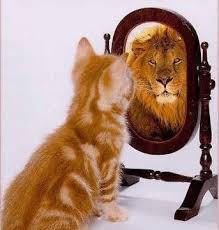
Confidence is one of the most studied, sought after, and revered human traits. We all aspire to have confidence. The confidence to ask for a raise, or a date, or the confidence to ask for the business. Nearly everything we do in life requires confidence. But do you know what ingredient is needed to super-charge your confidence? It’s conviction.
Years ago I found myself sitting in a meeting with the brilliant founder of Intuit, Scott Cook. In that meeting we were discussing why one of our product lines wasn’t acheiving the level of sales success we had anticipated. All of our research suggested it was due to a lack of brand awareness within that product category’s space.
At the end of our presentation Scott sat back and looked around the table. We were all quiet, anxiously awaiting his approval of the depth and quality of our work and findings. Instead he sat up, placed his arms on the table in a folded position and said, “I have a question. Raise your hand if you’ve ever heard of a Yugo.” We looked around the room at one another and quickly hands began to rise. Still looking around the room Scott then said, “Now keep your hand up if you’d buy a Yugo.” One by one hands came down and we now knew we were about to get schooled in the topic of brand awareness.
“Your problem is not with awareness. Your problem is that the market has no conviction in your product”. Scott effectively made the point that strong awareness without conviction equals failure. Our job was to instill conviction in the marketplace. Doing so required us to establish confidence first with our buyer. They needed to first “believe” we were capable of what we said we could do, and only THEN could they demonstrate their conviction to buy from us.
Establishing confidence begins with awareness, followed by increasing the buyers familiarity with your offering. Once familiar, the marketers job is to instill confidence. This can be done through a variety of ways including testimonials, surveys, samples, free trials, or a no-risk guarantee. Regardless of which method you use to instill this confidence it must be real before you can ask for the customers conviction to purchase.
To make this journey successfully you must be willing to truly hear what your customers are saying. You need to assess the marketplace. And perhaps most importantly you need to exude a personal conviction that by doing these things your business will grow with happy, delighted, and profitable customers.
Customer Journey Mapping: If you ask, be ready to listen and act
I’m attending a Marketing conference this week in Chicago. Much has been said about the importance of undertanding the customer buying journey. CMOs, SVPs of Marketing, and in some cases CEOs are talking about how much time and money they are spending to better understand their customers. Yet nothing is happening. Why?
Most companies fall into two categories: those willing to change how they go to market, and those that “say” they’re willing to change buy are simply not capable. The latter is not because of a lack of intellect or knowledge. Instead, companies not “capable” of change are typically those that are emboldened to the way they currently do things. It’s easier. It’s more comfortable. It’s familiar. Changing how you do business, and the interaction you have with your customer is scary. It’s unknown. As such only the most brave and courageous make the jump.
For those proposing or leading customer journey work consider the following:
- How involved has the current management/executive team been with customers? Are they speaking directly to customers? Are they in the field meeting with customers? Do they attend industry events and speak directly to customers and prospects? If the answer to any of these questions is “no” it’s likely you’ll struggle implementing the changes required to address your findings.
- What major changes have taken place over the past 12 months that affect the customer directly? Did you launch a net promoter measure? Is there a customer service center, and if so how is their success measured? What communication has been sent to your customers over the past year? Is it all sales related, or educational in nature? Have you been surveying for customer satisfaction? What have you learned?
- What’s the background of the CEO, COO, and President? If you work in a small organization those roles may all belong to the same person. That’s okay but the question still pertains. Does he or she have any customer experience?
- Your sample pool should be diverse yet random. Meaning, if you sell multiple products through the same sales and service channels you should look for customers with varying tenure with your firm, as well as different volumes of business.
- Have a project manager. You may not have that luxury…it may be you. How are your excel skills? How do you manage projects, timelines, deliverables? What’s your releationship with senior management to whom you’ll have to present your findings and recommendations?
I’ve conducted numerous customer journey mapping over the past decade. The customer is always changing…evolving.
 The impact of social media has become a catalyst for this change and will likely expedite it in the future. If you’re interested in learning more about conducting customer journey mapping send me a reply/comment and I will be happy to provide additional insight and guidance.
4 Ways to Super-Charge Your Leadership

If you want to super-charge your leadership skills here are 4 things you should pay close attention to:
- Behaviors – What you do, when you do them, how you do them. Do your behaviors change depending on circumstances or do they serve as an unshakeable foundation even in times of crisis? Be cognizant that people are watching. Your colleagues, bosses, clients, partners, are all noticing your behaviors.
- Routine – In a recent Harvard Business Review, it was reported that great leaders have routines. They do things in certain ways, at certain times. They are disciplined and methodical in their actions. Leaders who are skilled at identifying their surroundings and circumstances are able to develop the routines that add the greatest value resulting in better results.
- Adaptability – Great leaders are capable of modifying their behaviors and their routines based on their circumstances. This requires the leader to be both a teacher and student all at the same time. Recognizing the need to adjust, and as importantly how to adjust, sets great leaders apart from those individuals who manage. Managers watch over a process. Leaders evaluate circumstances, determine a better way, garner resources, provide vision, and secure alignment. To do this, a great leader must be able to adapt.
- Seek feedback…genuinely and often – Interesting research from a number of trusted sources indicates that leaders who request regular feedback are more effective. Feedback improves your ability to empathize and connect with others. Unfortunately many people interpret a request for feedback as a weakness or perhaps insecurity. Leaders who ask from a number of sources – not just their boss – gain deeper insight into the organization, its issues, challenges, opportunities, and people. Having the ability to see into your circumstances is critical to your success. Don’t let others perceptions of feedback affect yours or worse prevent you from asking.
Great leaders learn, teach others, learn more, and repeat that process. Take these 4 elements and weave them into your daily leadership actions.
3 Ways to a Strong Sales Finish

With 75 days left in the calendar year many salespeople find themselves in a crunch. Either a crunch to hit that next multiplier level for bonus money, or a crunch to simply get as close to plan as possible. Regardless of where you fall in that spectrum here are 3 things every sales pro should be doing right now:
- 70/30 split. At least 70% of your time should be spent with your current customers. You should be focused on understanding their business, providing value by educating them on possible solutions for their needs, and listening for trends, concerns, ideas, etc.
- Ask for the business. The closest thing to a silver bullet in Sales is asking for the business. Sure, you need to have earned the right to ask, but let’s assume you have. Too often sales people assume that if the customer had more business they would have already given it to them. WRONG! WRONG! WRONG! It’s not their job to give you anything. It’s your job to earn it, ask for it, and then deliver it in a way that makes you both memorable and remarkable.
- Be disciplined. There’s no such thing as a 9 – 5 sales job. If those are the hours you’re working you’re simply not doing enough. Oh…you’re already at quota working 9 – 5? Then I’d ask how much more you could have sold if you kicked it up a few notches? It’s time to push. Even if you’re at quota now a new sales year is right around the corner. Plan your days. Have your call list ready the night before. Don’t waste precious selling time getting ready. When you’re standing at the starting line it’s too late to train for the race.
Be sure you’re confronting reality. If you’ve missed plan this year take an inventory of where things went wrong. Be honest. At the end of the day if you’re over plan it’s because of you and if you’re under plan the reason is the same…you. You may be more expensive, of lesser quality, or longer to fulfill. Regardless, you own finding a new path. Once you accept accountability the path becomes much clearer.
Be calm. Sell on.
Starting Your Brand Journey
I love branding. I enjoy both the science and art of bringing a company to life through its brand. There are many elements that go into a successful brand launch and they all have the same starting point no matter what type of business you operate…your customer.
Understanding your customer, their needs, the market, their relationship (interaction) with your product, and trends are critical to developing a strong brand. Your brand is your promise. It’s what you commit to deliver to your customer. Your brand is not merely words, nor a visual image (logo) of your company. If your brand does not deliver the experience promised you’ve lost. Depending on how far the gap is between what was promised and what was delivered the cost of the misalignment can be catastrophic. Think of all the brands that have either disappeared of lost value. Circuit City, Kodak, RCA, E.F. Hutton, Chess King, and Zenith are all examples of companies that lost their way…lost their relevance to their customer base…failed to deliver on their promise.
In many cases the failure of these companies began in their failure to listen to their customers. Some call it hubris, others ignorance, still others arrogance. General Motors, once the king of the automotive industry lost its way when it failed to ignore the shift to more economical, better built vehicles. After nearly 20-plus years of declining market share they are slowly beginning to reestablish their credibility and position as an innovator of quality built vehicles.
If you’re about to begin a branding journey remember 2 things:
- Always start with your customer. Talk with them yourself. You may choose to use a partner, or agency, to assist in this process but hearing directly from your customers what they want, and what they find most important and valuable, is critical for your success.
- Involve key internal stakeholders from the beginning. People need to be bought into building what the customer asks for. If there is a disconnect between what the customer wants, what your brand represents or promises, and what you actually deliver, failure won’t be too far behind.
My final point is that your brand is a living, breathing thing. It develops, evolves, and morphs along the way providing you are paying attention to it. Your customers are changing far too quickly to think you can check a box and move on from a new logo, new website, or new marketing materials. Remember…listen. Take note. Engage your stakeholders. And act accordingly.
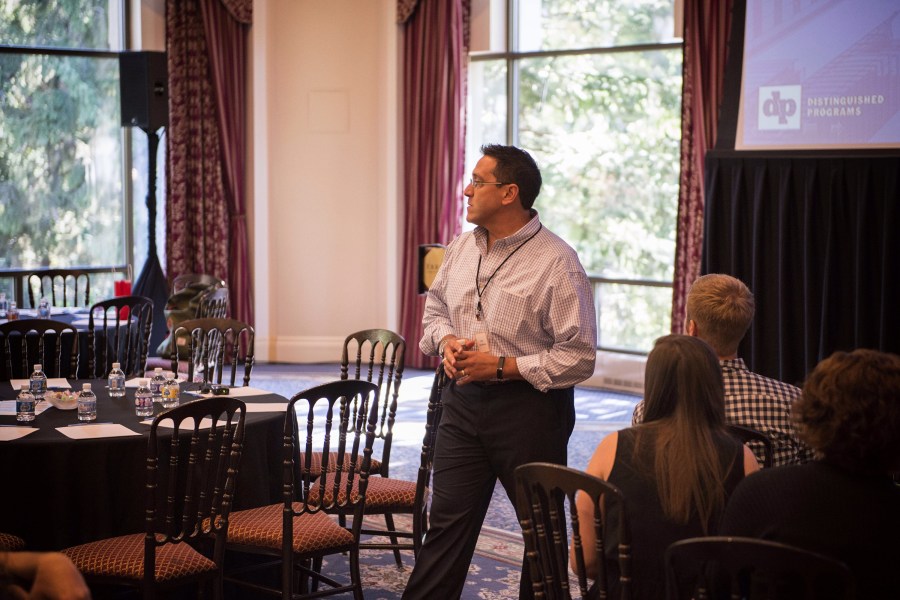
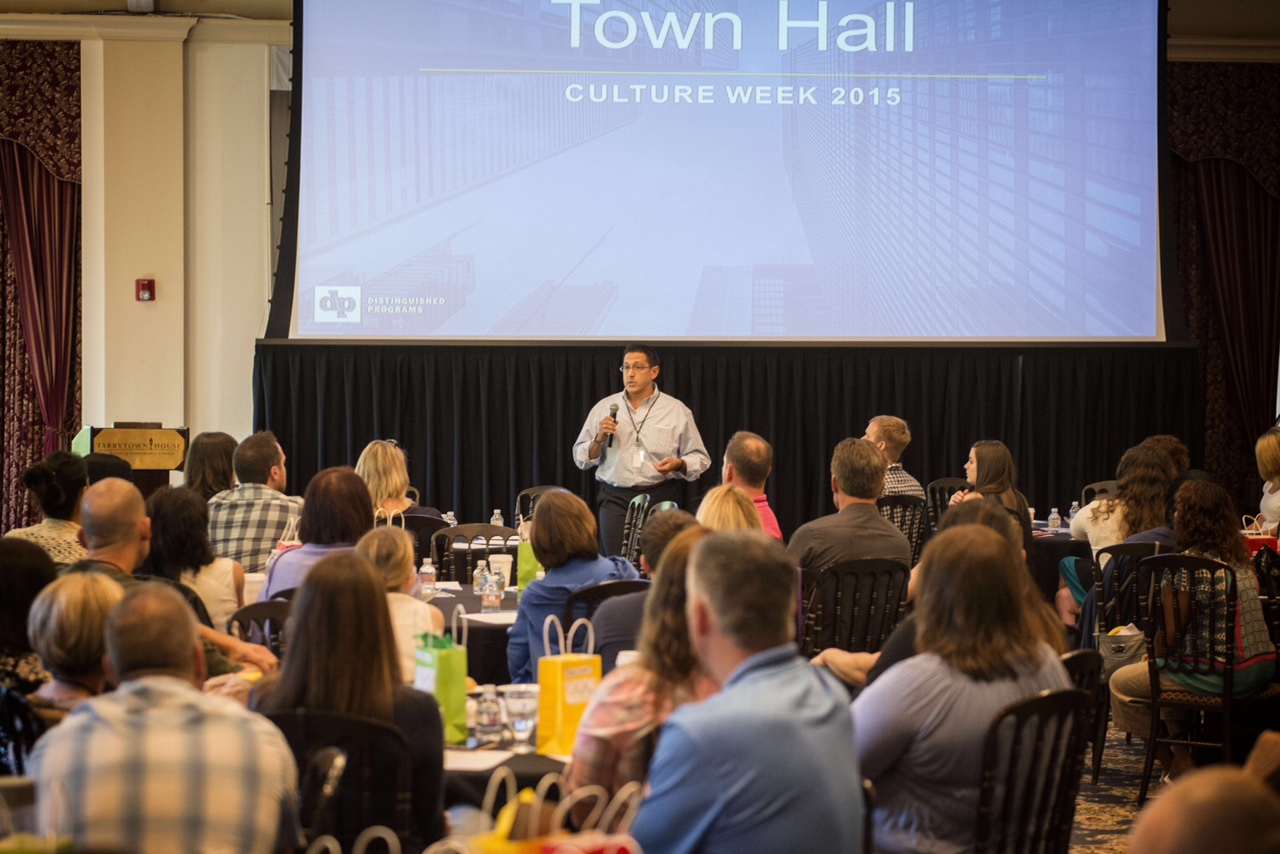
That’s me above announcing our new brand at an all-company Town Hall in September. So exciting. Check out http://www.distinguished.com
Thinking Differently – 6 Things To Challenge Your Current Paradigm

Last week I had the wonderful privilege of hearing a key-note speech by the incredible Seth Godin. I’ve read no less than half-dozen of his books and have seen him speak three times over the past few years. He never disappoints, always inspires and constantly challenges status-quo. Below are some key take-aways from that session.
- We are in the business of being talked about. Our message must be clear, it must connect, commit and communicate our culture. It must challenge the average.
- The definition of “everyone” is “average”. We don’t want to be like everyone.
- We all connect and react to things differently. Treat different people differently. Finding the exact thing that makes a connection to a specific individual or audience is critical.
- Don’t hold back. Give it your all every day. If you ask someone to raise their hand as high as they can…and then ask them to raise it a little higher they will. Don’t hold back. Raise your hand as high as you can every time. Do you do things “Full Joe, Full Amy, Full Sam”, or are you holding back? What’s the “full” you look like? Can you get there? If you don’t know your limits you haven’t tested them yet. You’re capable of far more than you may think.
- To be successful we must be in the business of experiments. Trying new things. “Destroying the perfect to enable the possible”. The more experiments the more opportunities. Think of all the experiments we’ve already done and how each of them have moved us forward.
- Don’t fear creativity or failure. Remember, “the guy who invented the ship also invented the shipwreck”. Be fearless. Own your successes, embrace your failures, and keep inventing.
Where Wisdom and Experience Intersect
Great leaders possess many characteristics. Courage, foresight, perspective, and vision are just a few thoughts that come to mind when thinking about leaders. Leaders are not all-knowing, nor do they have to be right all the time. In fact, knowing everything is impossible, and being right all of the time simply means you haven’t tested the boundaries. Good leaders fail. Great leaders fail often.
It’s been said that “wisdom is the result of experience, but experience is often the result of lack of wisdom.” So where do the two intersect? People ask you for advice because they admire your wisdom. Job opportunities because of your wisdom. Yet if it weren’t for all your failures you’d have nothing to offer, you would lack wisdom. Great leaders possess this knowledge because they understand the importance of failure. They are able to see failures as deposits into their bank of wisdom, not withdrawals or setbacks.
Wisdom allows us to take chances. It allows us to predict outcomes. It enables us to maximize our chance for success but it does not guarantee our success. Wisdom gives us the courage we need to attempt something that carries the risk of failure but doesn’t prevent us from trying. Failure must be an option as we try new things and expand our horizons. Wisdom helps us see that what we gain from these failures often times outweighs succeeding on the first try.
So when confronted with a choice between a sure thing and one that presents potential failure, look first to your wisdom bank. Do an honest assessment of what you will gain versus what’s at risk if you chose to take the chance. Know that if you do take a chance and fail, you now have wisdom to share with others. It is this wisdom that increases the value of your insight, perspective, and experience. It is this wisdom that makes you unique. This is the wisdom that enriches you personally, and the wisdom that develops you as a leader.
4 Keys To a Better S.A.L.E.

No matter if you’re new to sales or a seasoned sales executive, brushing up on your selling skills is as important as changing the oil in your car regularly. Leave the oil too long without changing it and your engine gunks up, gas mileage deteriorates, and in time your engine will fail. Knowledge is to the sales person what oil is to an engine. When you stop feeding your mind new knowledge your performance deteriorates and failure is around the corner. But with so many things to think about, so many calls to make, numbers to hit, you don’t know what to focus on first. So here’s a tip that will keep it simple…just remember SALE.
The “S” in Sale stands for structure. Every sales person needs structure. Some people are naturally disciplined and have strong internal structure while others require help to remain focused and disciplined. Only you can be honest enough with yourself to know where you fall on the structure spectrum. Structure includes when you make your calls, how your desk is set up, and whether your car is cleaned. Structure speaks to your ability to organize. Stronger organization equals higher efficiency which yields better results.
The “A” in Sale stands for attitude. John Maxwell, the famous inspirational author, wrote “your attitude determines your altitude.” Having a positive attitude is essential to success in life and critical to your success in Sales. Have you ever met a sales person who seemed like they were on their last leg? No more gas in their tank? How did that make you feel? Excited to buy? Confident in purchasing their product…from them? No. No one wants to work with someone with a poor attitude. No one buys from someone who lacks confidence in themselves, their product, or their company. If you’re honest enough to recognize you have a confidence gap – read. Thousands of books and books-on-tape are out their that can help. Take action. Don’t let another day go by with a bad attitude.
The “L” in Sale stands for learning. If you’re not a continuous learning become one…and fast. Albert Einstein said, “You have to learn the rules of the game. And then you have to play better than everyone else.” The rules of the game are always changing in Sales. Your customer is evolving. The internet and its ability to provide mountains of information will continue to change the game for years to come. Better educated customers and prospects force a sales person to constantly up their game. If you think the sales skills that won you awards 10 years ago, 5 years ago, or even last year will work in 2016 you’re wrong. News flash! If your buyer hasn’t already changed, they are in the process of changing. Read. As much as you can from as many sources as you can. Commit to bringing one or two points from what you read that day into your sales conversations, then watch how your customer engagements change before your eyes.
The “E” in Sale stands for energy. And lots of it. Sales is physically and mentally demanding. Some days are more draining that others. Break up your day. No matter how good you are you simply can’t sit and make 50 sales calls in a row without stopping. While that may be physically possible, your energy levels will diminish and your customer will sense it. Stay hydrated. Drink 4 – 5 glasses of water throughout the day, or bottles if more convenient. Stop for lunch. If you don’t have the time for lunch keep an energy and protein bar handy. You don’t want low energy levels to come across as poor attitude. And make sure you get a work-out in daily. Whether you start, or end, your day running, spinning, swimming or CrossFit, simply make sure to get some exercise in. It will help keep your mind fresh, your energy up, and your endurance strong.
Happy Selling!
3 Keys To Better Decision Making
We all make choices. Everyday each of us decides what we will do, not do, where to spend our time, who to share our love with, and who we choose to ignore. The decisions we make are informed by our experiences with people. Bad experience leads to one set of choices in how we act, good experiences lead to an entirely different set of choices. No matter, life is about choices. The goal is to make better choices more often than not. Doing this takes practice, self-reflection, and perspective. Try these 3 things the next time you need to make a difficult choice.
- Get it on paper. Put the circumstance in writing. Frame it. What’s the problem, the choice that needs to be made? Who are the people involved in that choice? Husband? Wife? Boss? Co-worker?
- List the various choices, or decisions, you could make and what the pros and cons are of each. Your internal compass is critical in this step. Often times making the right decision is difficlt to do. Beginning the decision making process by burdening yourself with what others will think will often times lead you to making a poor decision. Having the courage and intestinal fortitude to make the tough calls are what separates good decision makers from the bad.
- Finally, after you’ve identifed the best decision…your decision…consider its impact on those affected by this decision. The purpose of this step is not to second guess your decision, that’s already been made. Instead this step is necessary in order to create your story…your logical, intellectually sound story, that informs those impacted by this decision as to how you went about making your decision.
Difficult choices are never easy, and regardless of how logical your reasoning is you will never please everyone. Great leaders are those who can make difficult decisions, communicate those decisions, and get most people to buy into the decision they’ve made. Those leaders who focus on trying to get everyone to buy in to their decisions instead find themselves following more than leading. After all, if my choices were based upon what others did, felt, thought, etc, would I not by definition be following? Be a leader.
 Joseph DeRosa